Bolognia 5e·Dermatoloji Çalışma Paneli
Ch 66

Vitiligo ve Hipopigmentasyon Bozuklukları

Vol 1 · sayfa 1098 · §10
📖 Özet🃏 Flashcard Quiz🖼 Atlas
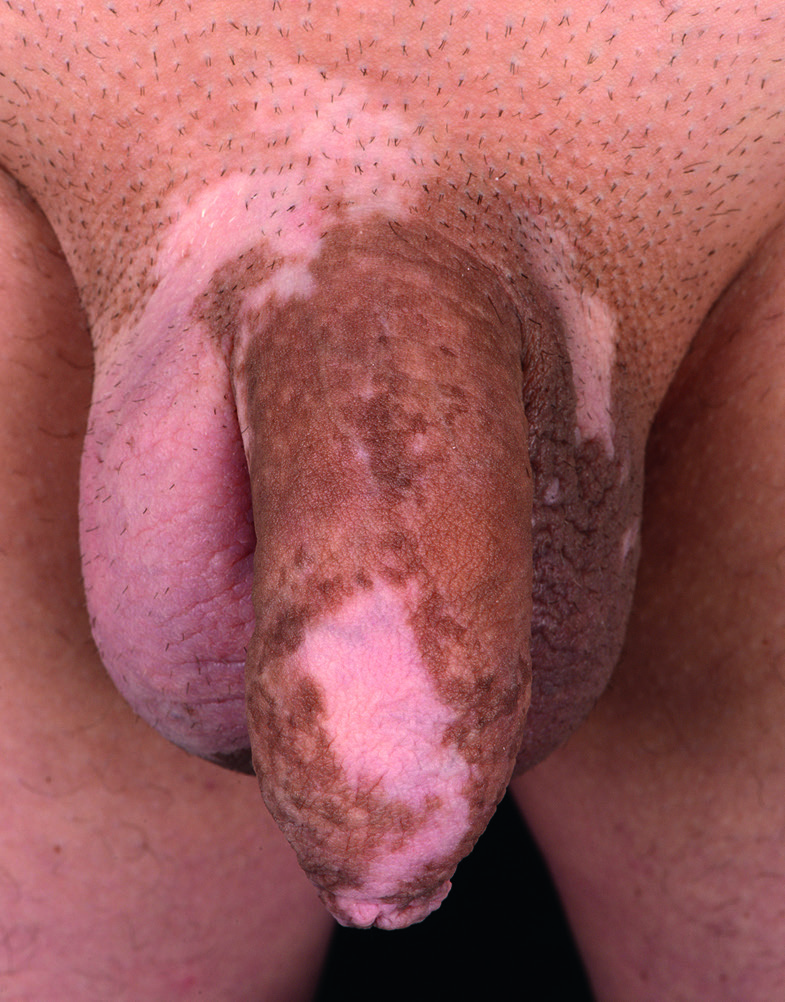
Fig. 66.2 Genital vitiligo. Complete loss of pigment on the penis and scrotum. Note the lack of any secondary changes. Courtesy Lorenzo Cerroni, MD.
Fig.66.2s.1339
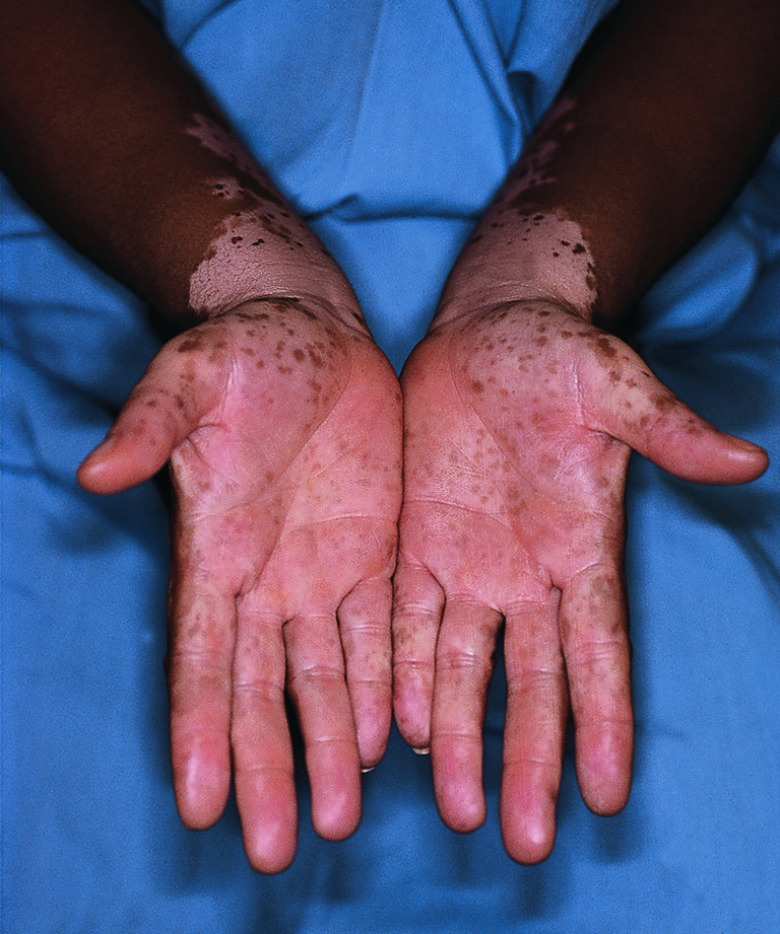
Fig. 66.3 Vitiligo. Depigmentation of the volar wrists as well as the palmar surfaces. Courtesy Jean L. Bolognia, MD.
Fig.66.3s.1339
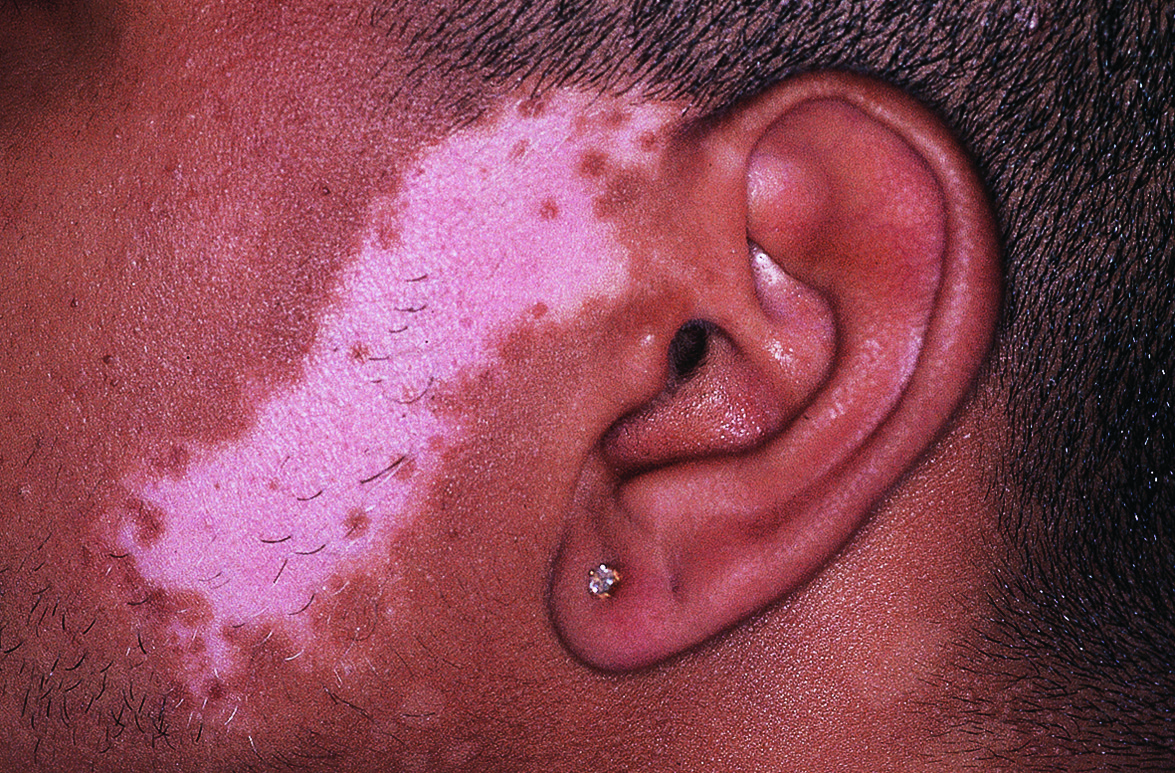
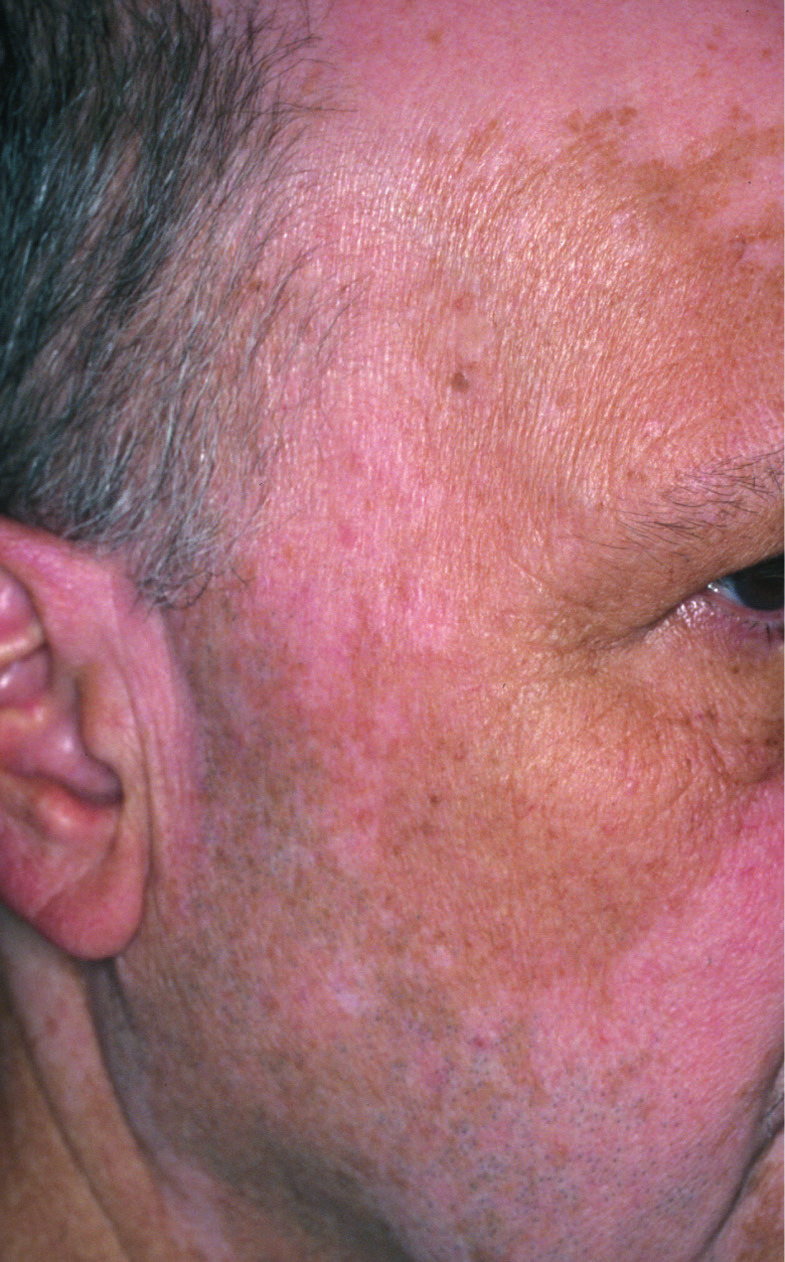
Fig. 66.5 Segmental vitiligo. Unilateral band of depigmentation on the face, the most common location for segmental vitiligo. Note the pigmented and depig- mented hairs within the affected area. Courtesy Kalman Watsky, MD.
Fig.66.5s.1340
Fig. 66.6 Segmental vitiligo. Under normal light, vitiligo can be subtle in lightly pigmented individuals. The clue to the diagnosis is the poliosis of the eyelashes. Courtesy Jean L. Bolognia, MD.
Fig.66.6s.1340
Fig. 66.7 Inflammatory vitiligo. An erythem- atous inflammatory border is evident. Such lesions are sometimes misdiagnosed as tinea corporis.
Fig.66.7 As.1341
Fig. 66.7 Inflammatory vitiligo. An erythem- atous inflammatory border is evident. Such lesions are sometimes misdiagnosed as tinea corporis.
Fig.66.7 Bs.1341
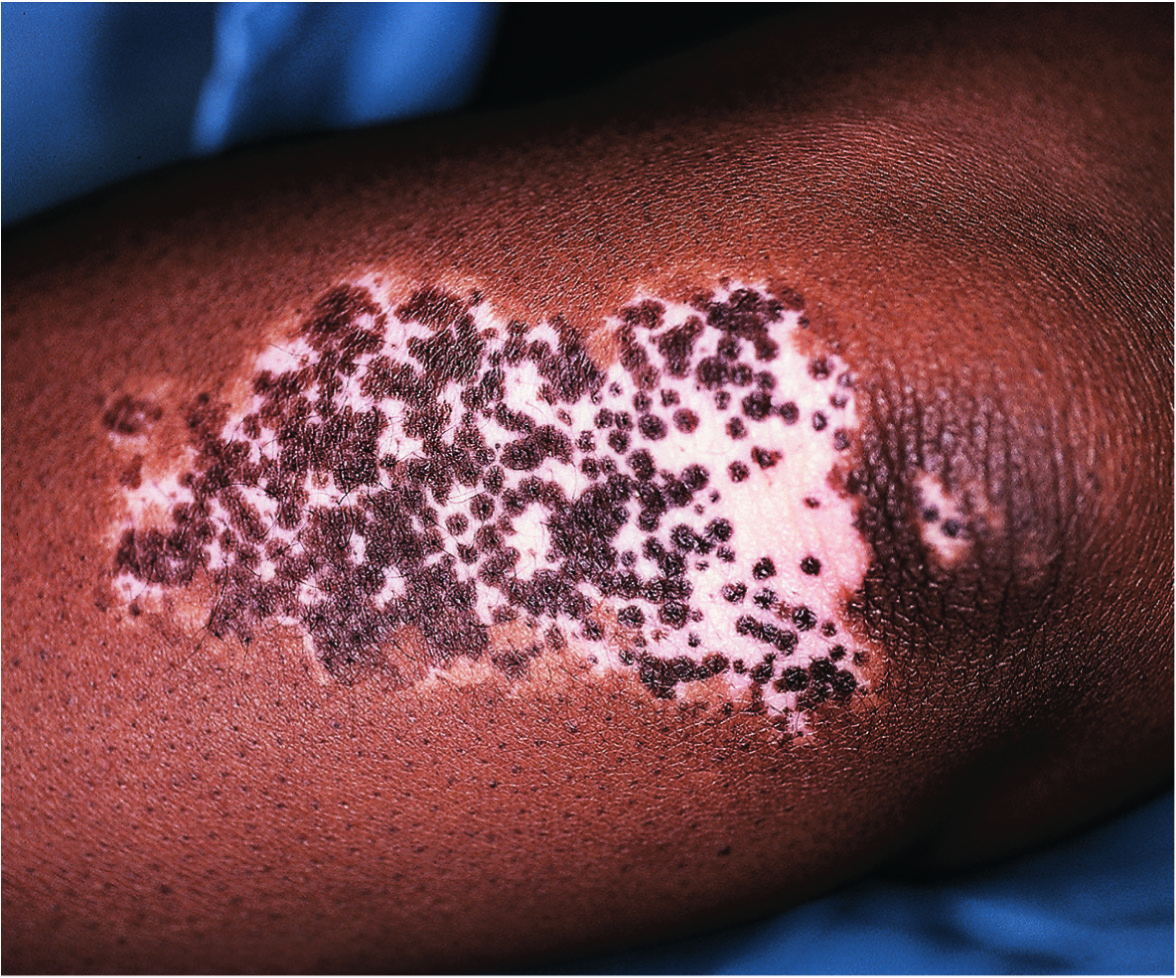
Fig. 66.9 Perifollicular repigmentation. Vitiligo on the elbow (A) and segmental vitiligo on the back (B) responding to PUVA and narrowband UVB therapy, respectively, with repigmentation in a prominent perifollicular pattern as well as from the periphery. The areas of repigmentation are darker in color than the uninvolved skin in (A) and have two shades (darker where well established and lighter at the expanding edge) in (B). A, Courtesy Jean L. Bolognia, MD; B, Courtesy Julie V. Schaffer, MD.
Fig.66.9 As.1342
Fig. 66.9 Perifollicular repigmentation. Vitiligo on the elbow (A) and segmental vitiligo on the back (B) responding to PUVA and narrowband UVB therapy, respectively, with repigmentation in a prominent perifollicular pattern as well as from the periphery. The areas of repigmentation are darker in color than the uninvolved skin in (A) and have two shades (darker where well established and lighter at the expanding edge) in (B). A, Courtesy Jean L. Bolognia, MD; B, Courtesy Julie V. Schaffer, MD.
Fig.66.9 Bs.1342
Fig. 66.10 Oculocutaneous albinism type 2 (OCA2). African patient with obvious squamous cell carcinomas on the cheek as well as multiple pigmented lentigines. Courtesy James Nordlund, MD.
Fig.66.10s.1345
Fig. 66.11 Oculocutaneous albinism type 2 (OCA2). African patient with hypopigmented hair and large pigmented lentigines. Courtesy James Nordlund, MD.
Fig.66.11s.1346
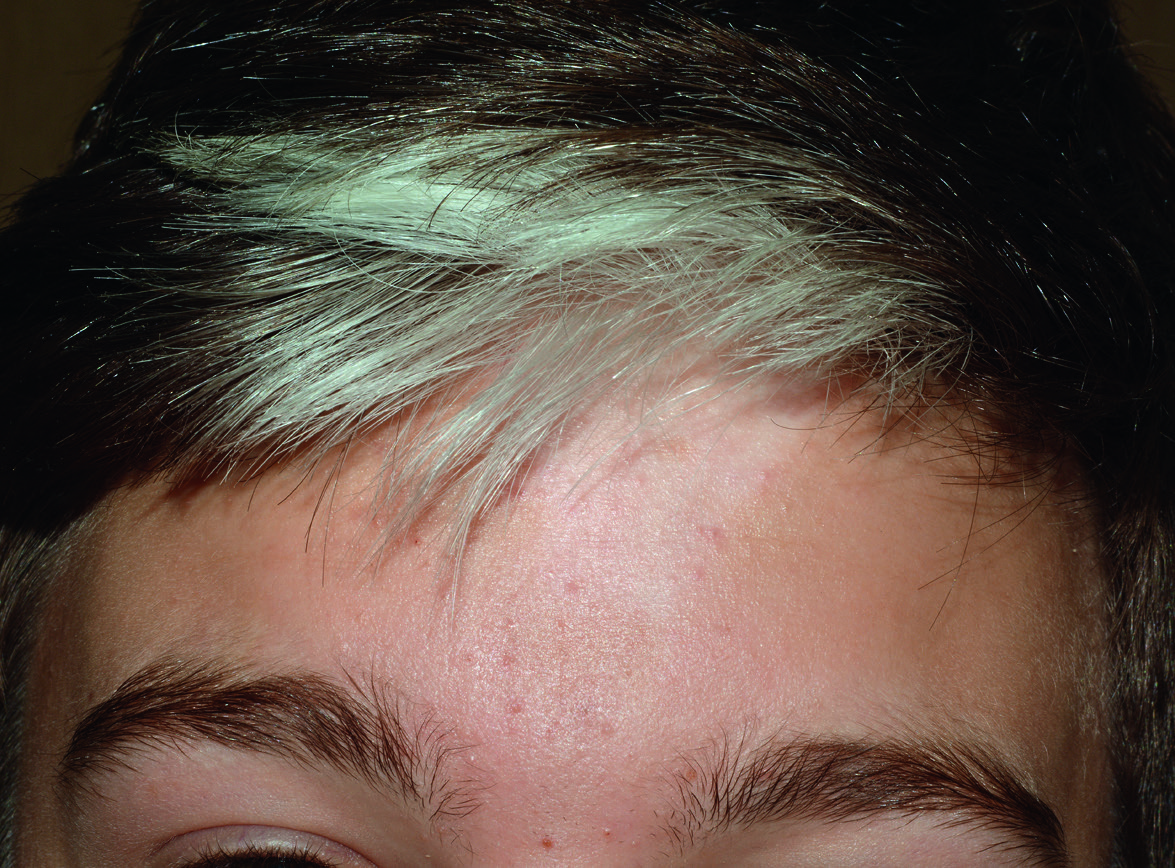
Fig. 66.13 Piebaldism. White forelock and characteristic triangular amelanotic patch on the mid-forehead. Courtesy Julie V. Schaffer, MD.
Fig.66.13s.1347
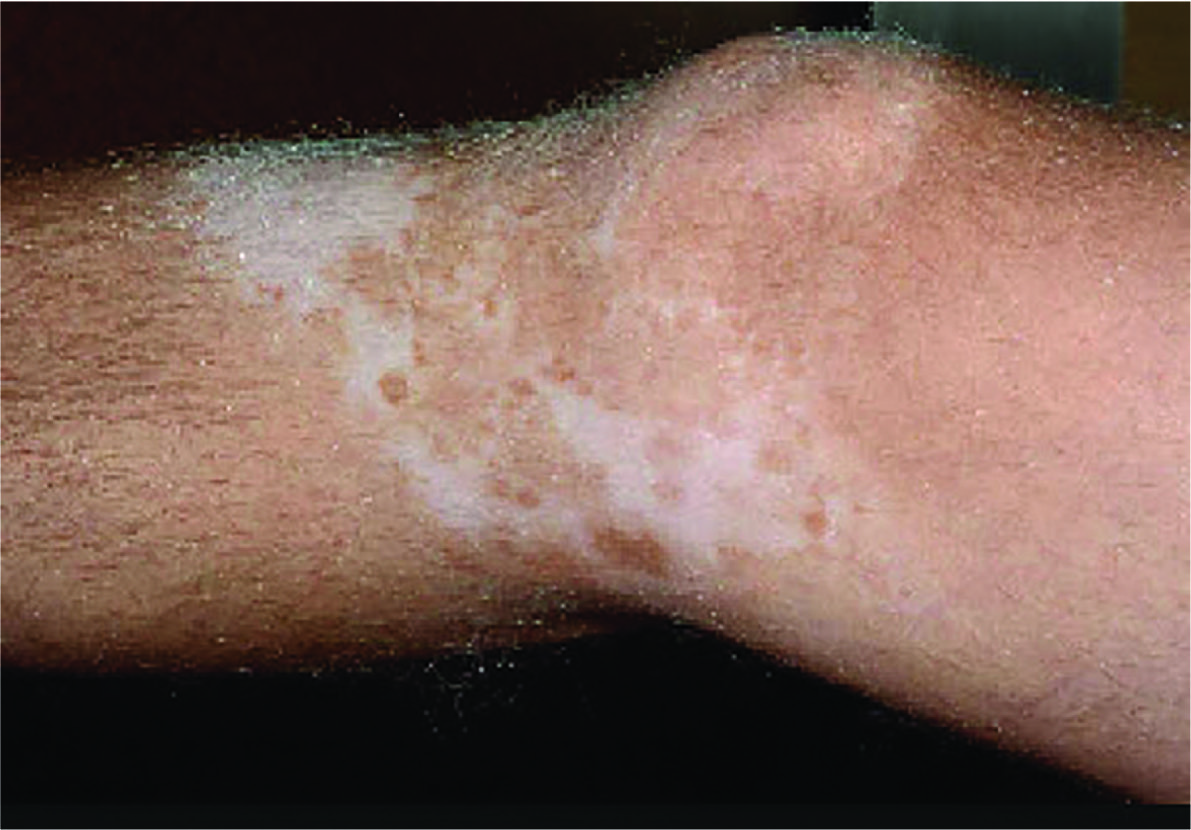
Fig. 66.14 Piebaldism. Characteristic involvement of the mid extremities. Note the normally pigmented and hyperpigmented macules within the leukoderma. Courtesy Julie V. Schaffer, MD.
Fig.66.14s.1347
Fig. 66.15 Waardenburg syndrome type 2. Heterochromia irides in the absence of dystopia canthorum. The white forelock is seen in the upper left corner. Courtesy Daniel Albert, MD.
Fig.66.15s.1349
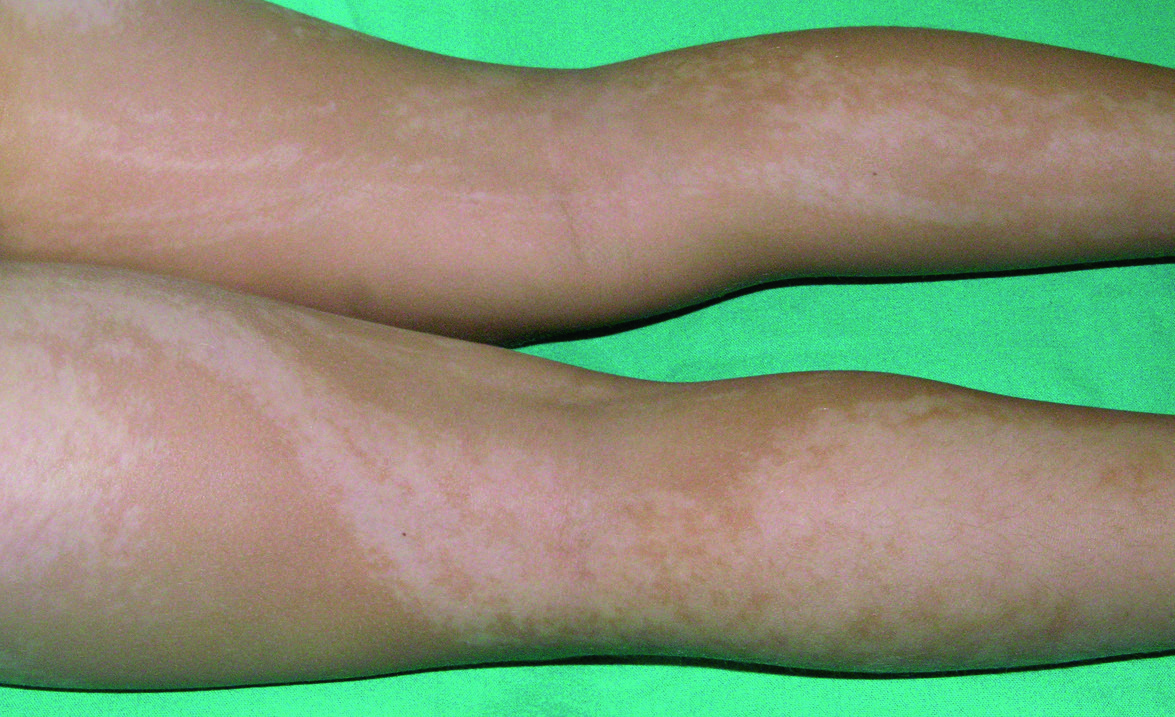
Fig. 66.16 Linear nevoid hypopigmentation. Hypopigmented streaks with various widths along the lines of Blaschko on the posterior lower extremities. Courtesy Antonio Torrelo, MD.
Fig.66.16s.1351
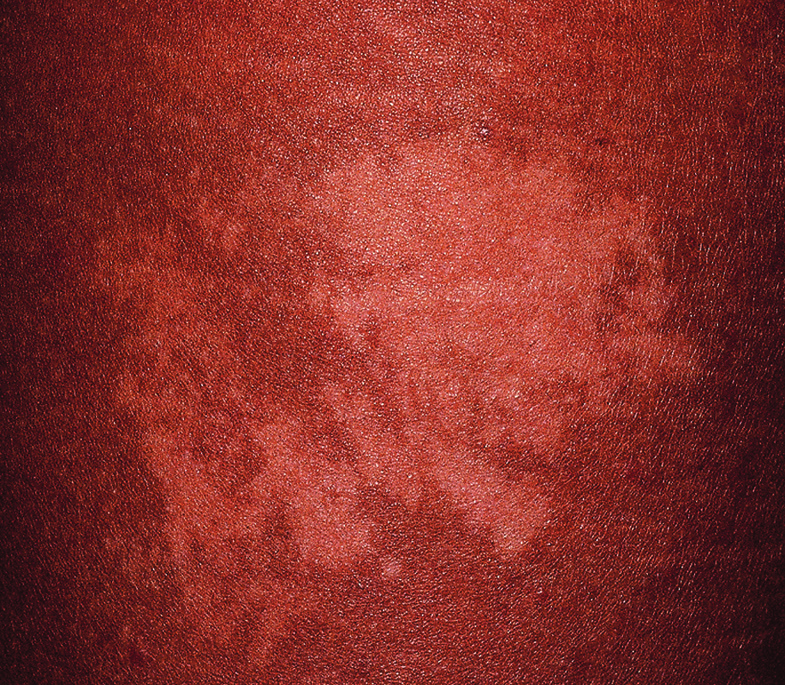
Fig. 66.17 Nevus depigmentosus. Hypomelanotic patch with a decrease, but not absence, of pigmentation.
Fig.66.17s.1351
Fig. 66.19 Postinflammatory hypopig- mentation. Hypopigmentation secondary to psoriasis (A), seborrheic dermatitis in an infant (B), pityriasis lichenoides chronica (C, D), and lichen striatus (E). Note the subtle flat-topped papules in the latter. Complete pigment loss in patients with severe atopic dermatitis (F), neonatal lupus erythema- tosus (G), and discoid lupus erythema- tosus (H). B, Courtesy Jean L. Bolognia, MD; E, G, Courtesy Julie V. Schaffer, MD.
Fig.66.19 As.1353
Fig. 66.19 Postinflammatory hypopig- mentation. Hypopigmentation secondary to psoriasis (A), seborrheic dermatitis in an infant (B), pityriasis lichenoides chronica (C, D), and lichen striatus (E). Note the subtle flat-topped papules in the latter. Complete pigment loss in patients with severe atopic dermatitis (F), neonatal lupus erythema- tosus (G), and discoid lupus erythema- tosus (H). B, Courtesy Jean L. Bolognia, MD; E, G, Courtesy Julie V. Schaffer, MD.
Fig.66.19 Bs.1353
Fig. 66.19 Postinflammatory hypopig- mentation. Hypopigmentation secondary to psoriasis (A), seborrheic dermatitis in an infant (B), pityriasis lichenoides chronica (C, D), and lichen striatus (E). Note the subtle flat-topped papules in the latter. Complete pigment loss in patients with severe atopic dermatitis (F), neonatal lupus erythema- tosus (G), and discoid lupus erythema- tosus (H). B, Courtesy Jean L. Bolognia, MD; E, G, Courtesy Julie V. Schaffer, MD.
Fig.66.19 Cs.1353
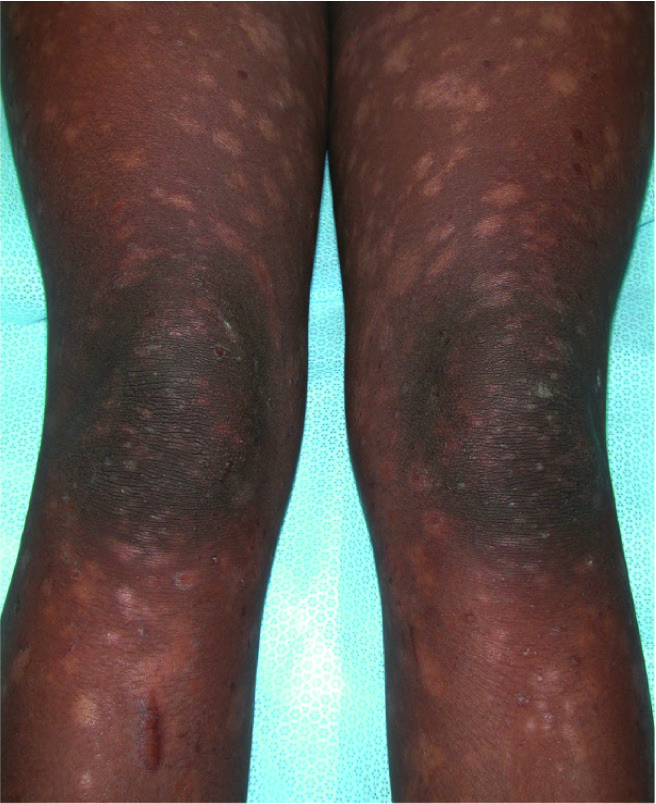
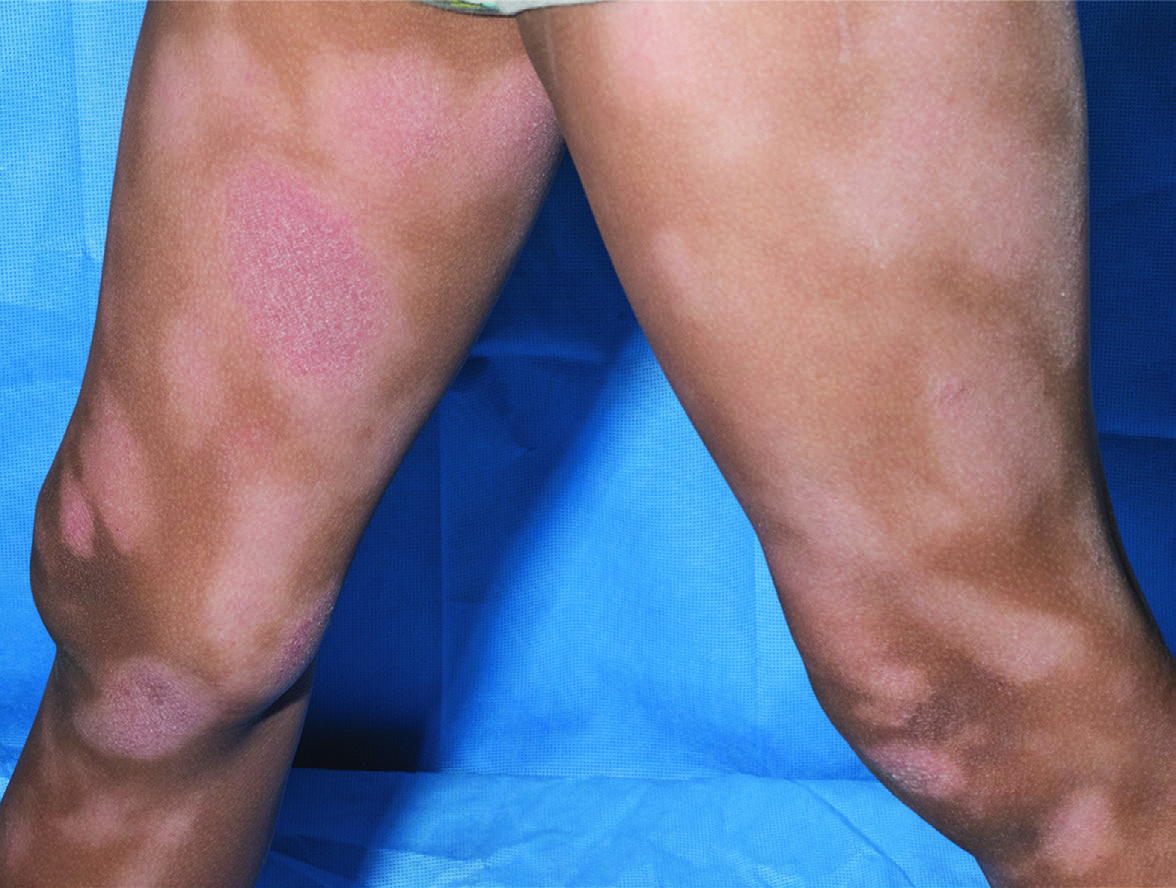
Fig. 66.20 Hypopigmented mycosis fungoides. A Variant with an admixture of classic erythematous lesions and hypopigmented patches with scale on the legs in an adolescent. B Purely hypopigmented lesions of variable sizes on the back and buttocks of a child. A, Courtesy Edward Cowen, MD; B, Courtesy Julie V. Schaffer, MD.
Fig.66.20 As.1354
Fig. 66.20 Hypopigmented mycosis fungoides. A Variant with an admixture of classic erythematous lesions and hypopigmented patches with scale on the legs in an adolescent. B Purely hypopigmented lesions of variable sizes on the back and buttocks of a child. A, Courtesy Edward Cowen, MD; B, Courtesy Julie V. Schaffer, MD.
Fig.66.20 Bs.1354
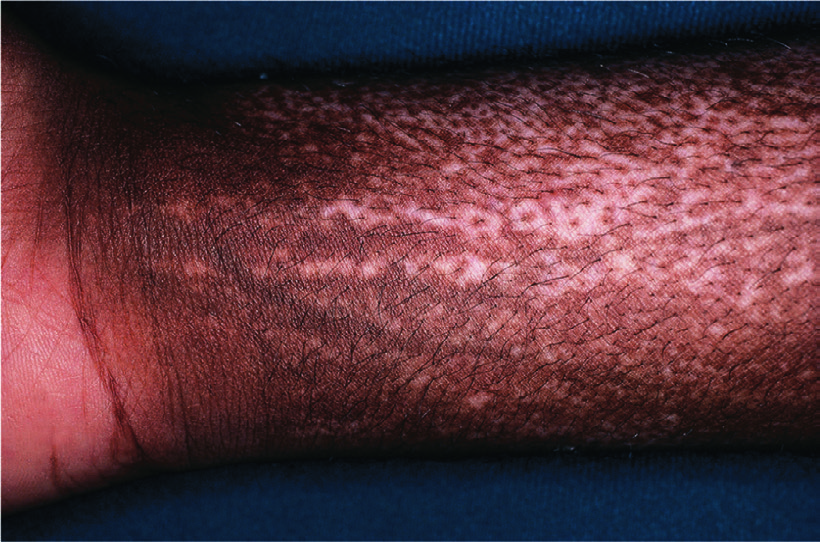
Fig. 66.21 Leukoderma of systemic sclerosis (scleroderma). Uniform retention of perifollicular pigment within areas of leukoderma. Hyperpigmentation is also seen overlying a superficial vein.
Fig.66.21s.1354
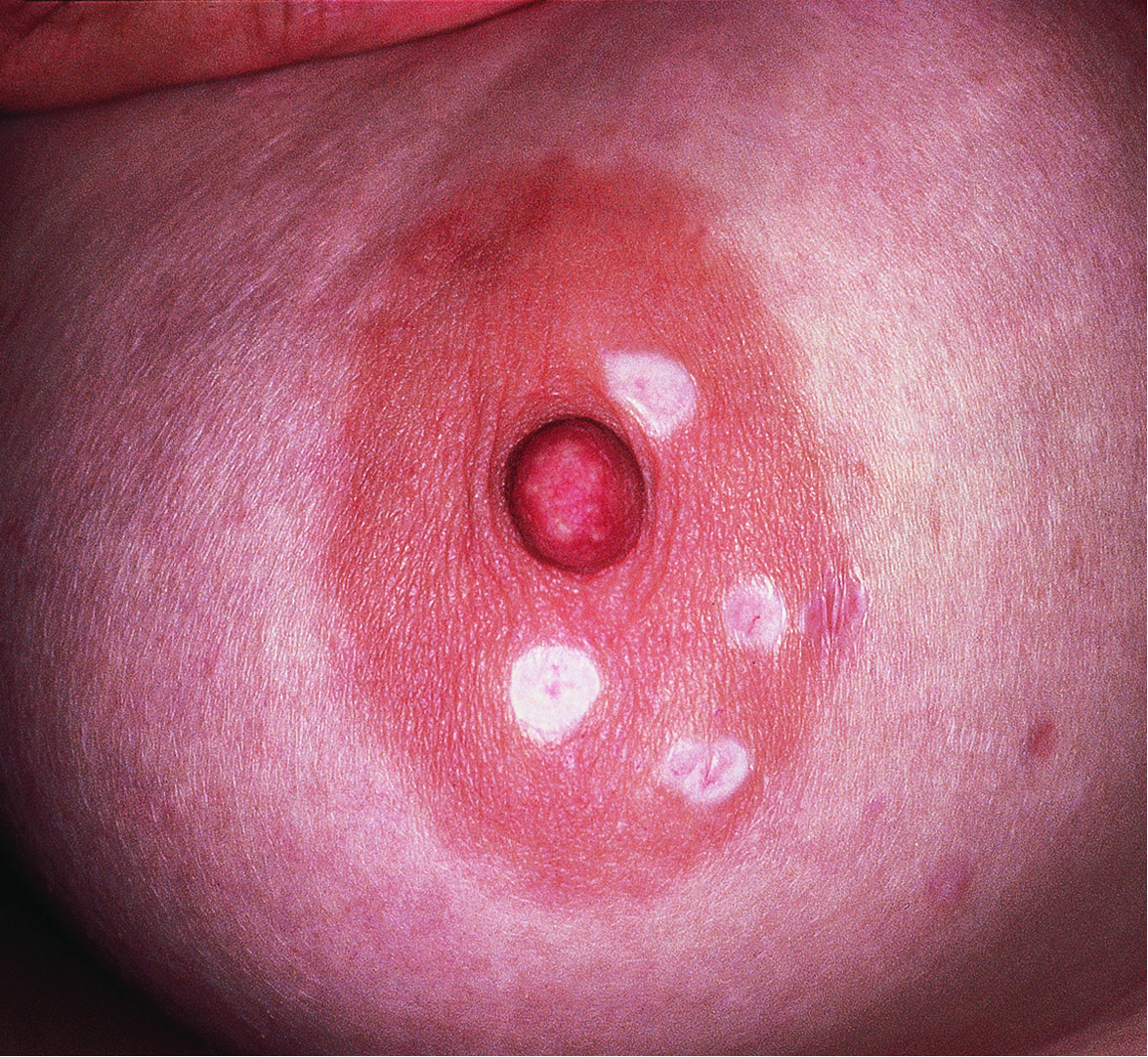
Fig. 66.22 Guttate lichen sclerosus involving the areola.
Fig.66.22s.1354
Fig. 66.23 Tinea versicolor. A Hypopigmented variant with obvious scale. B Guttate hypopigmented lesions on the lateral cheek of a child; note the classic scaly lesions in the posterior auricular area. B, Courtesy Julie V. Schaffer, MD.
Fig.66.23 As.1355
Fig. 66.23 Tinea versicolor. A Hypopigmented variant with obvious scale. B Guttate hypopigmented lesions on the lateral cheek of a child; note the classic scaly lesions in the posterior auricular area. B, Courtesy Julie V. Schaffer, MD.
Fig.66.23 Bs.1355
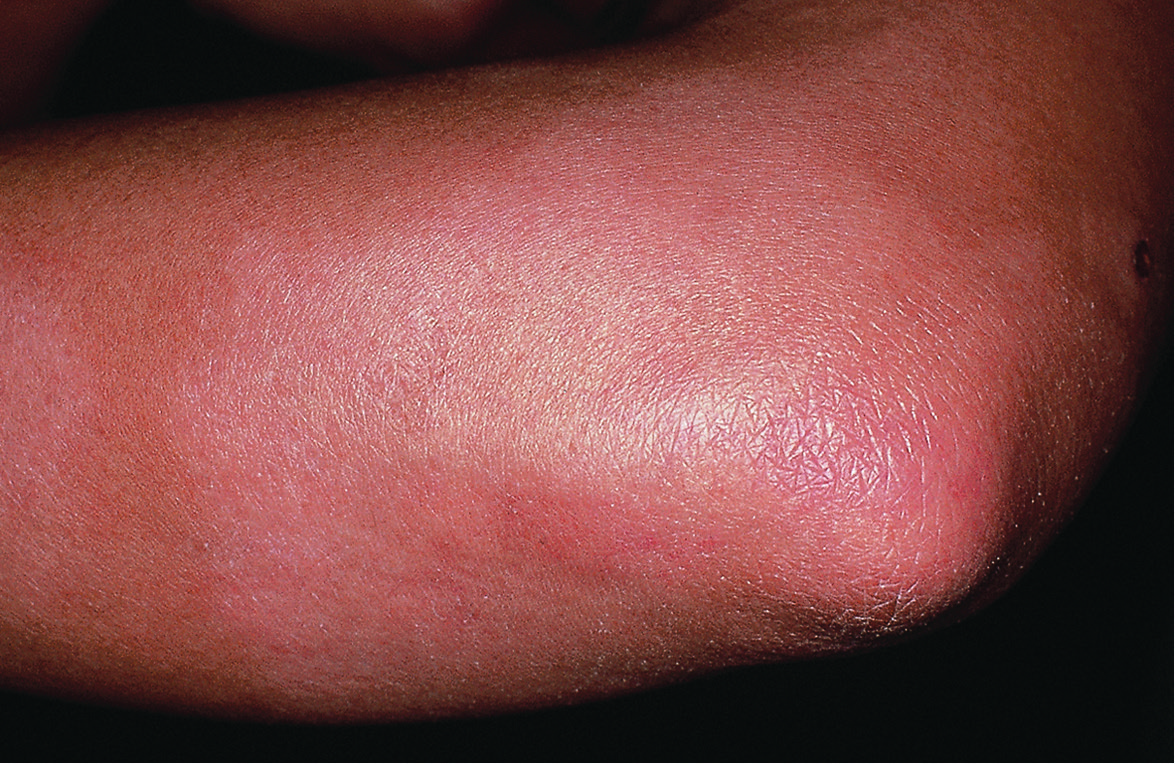
Fig. 66.24 Tuberculoid leprosy. Large, thin hypopigmented plaque on the elbow with a raised light pink border.
Fig.66.24s.1355
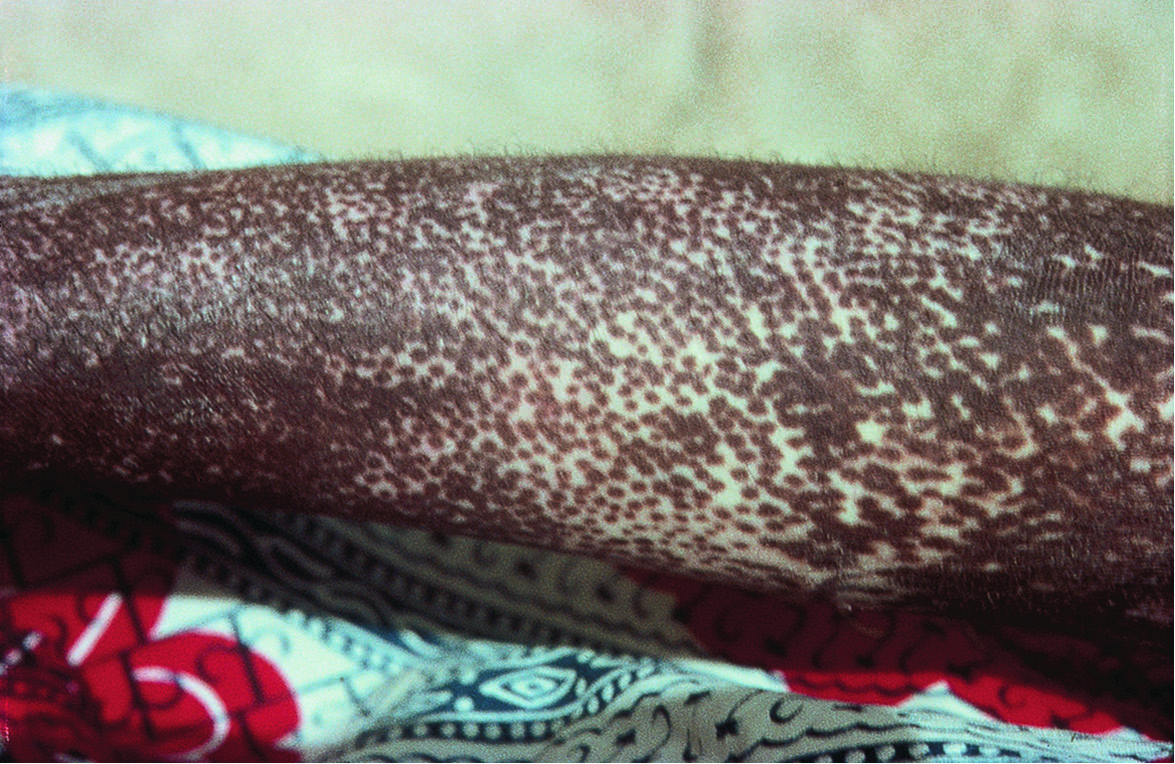
Fig. 66.25 Onchocerciasis (leopard skin). Depigmentation of the shin with follicular repigmentation or retention of perifollicular pigment, a common site for the associated leukoderma.
Fig.66.25s.1356
Fig. 66.27 Vitiligo-like leukoderma associated with anti-cytotoxic T lymphocyte-associated antigen-4 (CTLA-4) therapy for metastatic melanoma. Courtesy Jean L. Bolognia, MD.
Fig.66.27s.1357
Fig. 66.28 Hypopigmentation due to injection of corticosteroids into the anatomic snuff box. The outline is both stellate and linear.
Fig.66.28 As.1358
Fig. 66.28 Hypopigmentation due to injection of corticosteroids into the anatomic snuff box. The outline is both stellate and linear.
Fig.66.28 Bs.1358
Fig. 66.30 Idiopathic guttate hypomelanosis. A Typical 1–5 mm macules on the shin. B Occasionally there is admixture of larger lesions.
Fig.66.30 As.1359
Fig. 66.30 Idiopathic guttate hypomelanosis. A Typical 1–5 mm macules on the shin. B Occasionally there is admixture of larger lesions.
Fig.66.30 Bs.1359
Fig. 66.30 Idiopathic guttate hypomelanosis. A Typical 1–5 mm macules on the shin. B Occasionally there is admixture of larger lesions.
Fig.66.30 Cs.1359
Fig. 66.31 Guttate leukoderma. A Disseminated hypopigmented keratoses presenting as >200 guttate, minimally elevated hypopigmented papules. The lesions developed after several months of PUVA therapy. Histologically, there was no evidence of verruca plana. B Clear cell papulosis presenting as multiple hypopig- mented, barely elevated, small flat-topped papules and macules in the suprapubic area and on the abdomen along the “milk lines” in a 2-year-old boy. Histologically, these lesions are characterized by large clear cells in the lower epidermis that have a pattern of immunohistochemical staining similar to clear cells of Toker and extra- mammary Paget disease. C Guttate hypopigmentation in sun-exposed areas on the extensor aspect of the arm in a 3-year-old Hispanic boy with xeroderma pigmen- tosum. Note the sparing of the proximal upper arm, which is normally covered by a T-shirt. A, Courtesy Jean L. Bolognia, MD; B, C, Courtesy Julie V. Schaffer, MD.
Fig.66.31 As.1359
Fig. 66.31 Guttate leukoderma. A Disseminated hypopigmented keratoses presenting as >200 guttate, minimally elevated hypopigmented papules. The lesions developed after several months of PUVA therapy. Histologically, there was no evidence of verruca plana. B Clear cell papulosis presenting as multiple hypopig- mented, barely elevated, small flat-topped papules and macules in the suprapubic area and on the abdomen along the “milk lines” in a 2-year-old boy. Histologically, these lesions are characterized by large clear cells in the lower epidermis that have a pattern of immunohistochemical staining similar to clear cells of Toker and extra- mammary Paget disease. C Guttate hypopigmentation in sun-exposed areas on the extensor aspect of the arm in a 3-year-old Hispanic boy with xeroderma pigmen- tosum. Note the sparing of the proximal upper arm, which is normally covered by a T-shirt. A, Courtesy Jean L. Bolognia, MD; B, C, Courtesy Julie V. Schaffer, MD.
Fig.66.31 Bs.1359
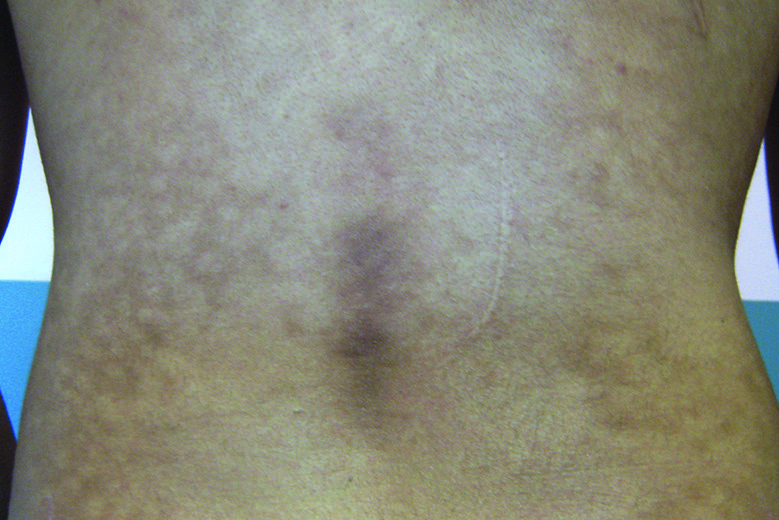
Fig. 66.32 Progressive macular hypomelanosis. Note the coalescence of the non-scaly hypopig- mented macules on the center of the back.
Fig.66.32s.1360