Bolognia 5e·Dermatoloji Çalışma Paneli
Ch 69

Alopesiler

Vol 1 · sayfa 1173 · §11
📖 Özet🃏 Flashcard Quiz🖼 Atlas
Fig. 69.2 Diagnostic tests for the assessment of alopecia. Additional inves- tigations include fungal culture, Wood’s lamp examination, scalp biopsy, polarized light microscopy of scalp hairs, and blood tests.
Fig.69.2s.1422
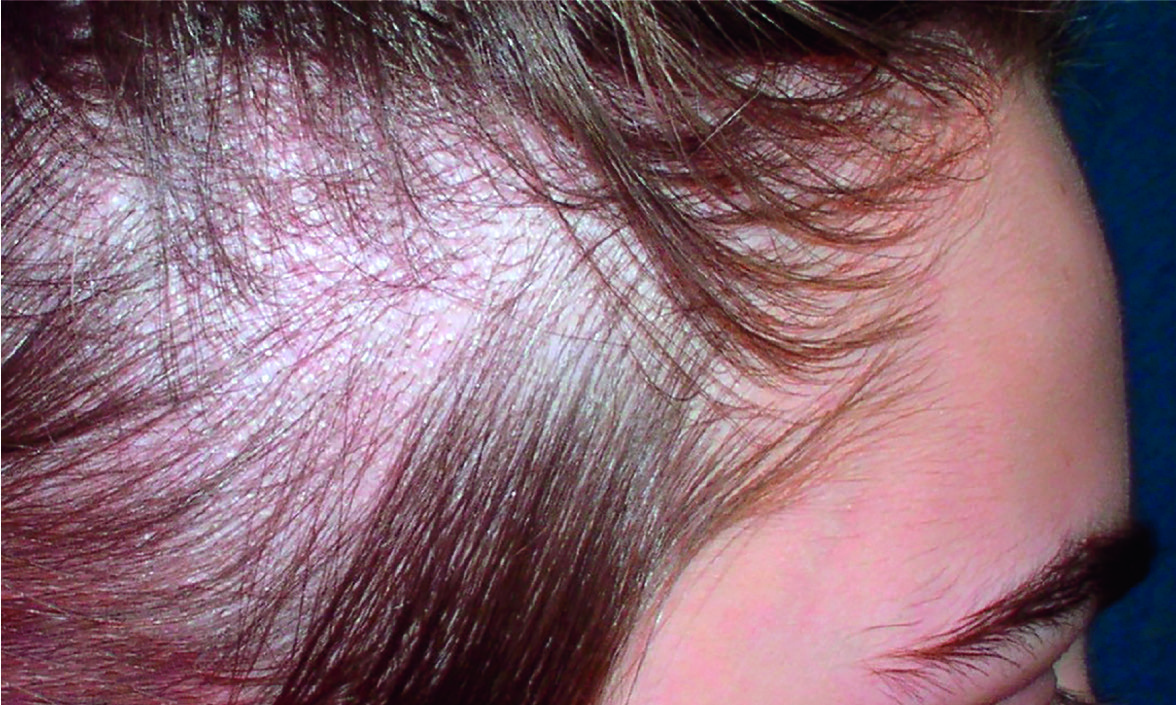
Fig. 69.3 Female androgenetic alopecia. A Prior to treatment. Note the greater hair loss anteriorly. B Obvious improvement following 5 years of therapy. Androgenetic alopecia may be at least partially reversible, when treated early. Courtesy Rodney D. Sinclair, MD.
Fig.69.3 As.1422
Fig. 69.3 Female androgenetic alopecia. A Prior to treatment. Note the greater hair loss anteriorly. B Obvious improvement following 5 years of therapy. Androgenetic alopecia may be at least partially reversible, when treated early. Courtesy Rodney D. Sinclair, MD.
Fig.69.3 Bs.1422
Fig. 69.4 Female androgenetic alopecia. Comparison of the part line on the top of the scalp (A) and the occiput (B). Courtesy Leonard C. Sperling, MD.
Fig.69.4s.1422
Fig. 69.5 The Sinclair scale for female androgenetic alopecia. Stage 1 – normal; Stage 2 – widening of the central part line; Stage 3 – widening of the part line with translucency of the hairs at its border; Stage 4 – development of a bald area anteriorly along the part line; and Stage 5 – advanced hair loss. Courtesy Rodney D. Sinclair, MD.
Fig.69.5 As.1423
Sinclair scale 5 (see Fig. 69.5)
Fig.69.5 Bs.1423
Sinclair scale 5 (see Fig. 69.5)
Fig.69.5 Cs.1423
Fig. 69.5 The Sinclair scale for female androgenetic alopecia. Stage 1 – normal; Stage 2 – widening of the central part line; Stage 3 – widening of the part line with translucency of the hairs at its border; Stage 4 – development of a bald area anteriorly along the part line; and Stage 5 – advanced hair loss. Courtesy Rodney D. Sinclair, MD.
Fig.69.5 Ds.1423
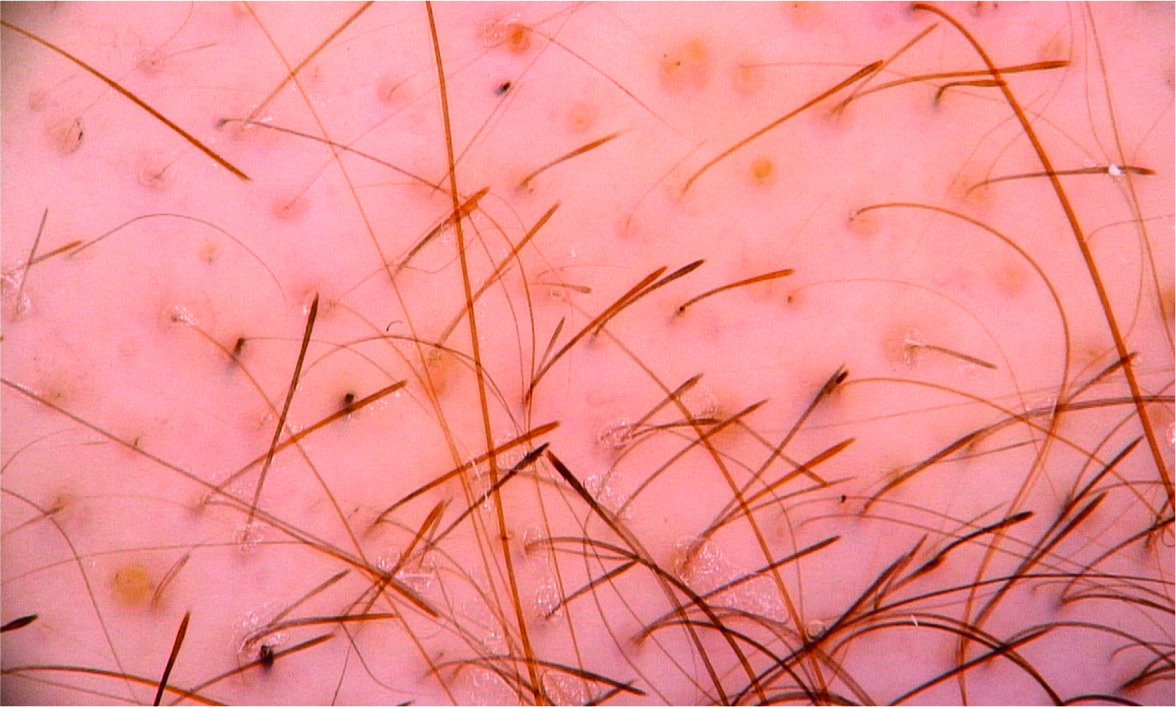
Fig. 69.6 Androgenetic alopecia – trichoscopic features. Full-thickness terminal hairs, intermediate hairs, thin hairs, and very thin (vellus) hairs are all observed simultaneously. This heterogeneity of hair shaft thickness is due to non-synchronized hair miniaturization.
Fig.69.6s.1423
Fig. 69.7 Common trichoscopy findings. A Healthy hairs are uniform in color and shape throughout their length. The follicular units contain 1 to 4 hairs (average, 2.3). B Exclamation point hair – observed primarily in alopecia areata, trichotillomania, and chemotherapy-induced alopecia. C Comma hairs – tinea capitis. D Broken hair – trichotillomania, tinea capitis, and alopecia areata. E Yellow dots – alopecia areata and androgenetic alopecia. F Black dots – alopecia areata, tinea capitis, trichotillomania, and anagen effluvium. G Perifollicular pustule – folliculitis decalvans. H Hair tufts consisting of more than 5 hairs per follicular unit (“tufted follicu- litis”) – folliculitis decalvans. I Perifollicular scaling – lichen planopilaris, folliculitis decalvans, and frontal fibrosing alopecia. J Seropurulent exudate – dissecting cellu- litis and tinea capitis. K Thick arborizing vessels and tortuous vessels – systemic lupus erythematosus. L Upright regrowing hair (healthy regrowing). Zigzag hairs can be seen in tinea capitis.
Fig.69.7 As.1424
Fig. 69.7 Common trichoscopy findings. A Healthy hairs are uniform in color and shape throughout their length. The follicular units contain 1 to 4 hairs (average, 2.3). B Exclamation point hair – observed primarily in alopecia areata, trichotillomania, and chemotherapy-induced alopecia. C Comma hairs – tinea capitis. D Broken hair – trichotillomania, tinea capitis, and alopecia areata. E Yellow dots – alopecia areata and androgenetic alopecia. F Black dots – alopecia areata, tinea capitis, trichotillomania, and anagen effluvium. G Perifollicular pustule – folliculitis decalvans. H Hair tufts consisting of more than 5 hairs per follicular unit (“tufted follicu- litis”) – folliculitis decalvans. I Perifollicular scaling – lichen planopilaris, folliculitis decalvans, and frontal fibrosing alopecia. J Seropurulent exudate – dissecting cellu- litis and tinea capitis. K Thick arborizing vessels and tortuous vessels – systemic lupus erythematosus. L Upright regrowing hair (healthy regrowing). Zigzag hairs can be seen in tinea capitis.
Fig.69.7 Bs.1424
Fig. 69.7 Common trichoscopy findings. A Healthy hairs are uniform in color and shape throughout their length. The follicular units contain 1 to 4 hairs (average, 2.3). B Exclamation point hair – observed primarily in alopecia areata, trichotillomania, and chemotherapy-induced alopecia. C Comma hairs – tinea capitis. D Broken hair – trichotillomania, tinea capitis, and alopecia areata. E Yellow dots – alopecia areata and androgenetic alopecia. F Black dots – alopecia areata, tinea capitis, trichotillomania, and anagen effluvium. G Perifollicular pustule – folliculitis decalvans. H Hair tufts consisting of more than 5 hairs per follicular unit (“tufted follicu- litis”) – folliculitis decalvans. I Perifollicular scaling – lichen planopilaris, folliculitis decalvans, and frontal fibrosing alopecia. J Seropurulent exudate – dissecting cellu- litis and tinea capitis. K Thick arborizing vessels and tortuous vessels – systemic lupus erythematosus. L Upright regrowing hair (healthy regrowing). Zigzag hairs can be seen in tinea capitis.
Fig.69.7 Cs.1424
Fig. 69.7 Common trichoscopy findings. A Healthy hairs are uniform in color and shape throughout their length. The follicular units contain 1 to 4 hairs (average, 2.3). B Exclamation point hair – observed primarily in alopecia areata, trichotillomania, and chemotherapy-induced alopecia. C Comma hairs – tinea capitis. D Broken hair – trichotillomania, tinea capitis, and alopecia areata. E Yellow dots – alopecia areata and androgenetic alopecia. F Black dots – alopecia areata, tinea capitis, trichotillomania, and anagen effluvium. G Perifollicular pustule – folliculitis decalvans. H Hair tufts consisting of more than 5 hairs per follicular unit (“tufted follicu- litis”) – folliculitis decalvans. I Perifollicular scaling – lichen planopilaris, folliculitis decalvans, and frontal fibrosing alopecia. J Seropurulent exudate – dissecting cellu- litis and tinea capitis. K Thick arborizing vessels and tortuous vessels – systemic lupus erythematosus. L Upright regrowing hair (healthy regrowing). Zigzag hairs can be seen in tinea capitis.
Fig.69.7 Ds.1424
Fig. 69.7 Common trichoscopy findings. A Healthy hairs are uniform in color and shape throughout their length. The follicular units contain 1 to 4 hairs (average, 2.3). B Exclamation point hair – observed primarily in alopecia areata, trichotillomania, and chemotherapy-induced alopecia. C Comma hairs – tinea capitis. D Broken hair – trichotillomania, tinea capitis, and alopecia areata. E Yellow dots – alopecia areata and androgenetic alopecia. F Black dots – alopecia areata, tinea capitis, trichotillomania, and anagen effluvium. G Perifollicular pustule – folliculitis decalvans. H Hair tufts consisting of more than 5 hairs per follicular unit (“tufted follicu- litis”) – folliculitis decalvans. I Perifollicular scaling – lichen planopilaris, folliculitis decalvans, and frontal fibrosing alopecia. J Seropurulent exudate – dissecting cellu- litis and tinea capitis. K Thick arborizing vessels and tortuous vessels – systemic lupus erythematosus. L Upright regrowing hair (healthy regrowing). Zigzag hairs can be seen in tinea capitis.
Fig.69.7 Es.1424
Fig. 69.7 Common trichoscopy findings. A Healthy hairs are uniform in color and shape throughout their length. The follicular units contain 1 to 4 hairs (average, 2.3). B Exclamation point hair – observed primarily in alopecia areata, trichotillomania, and chemotherapy-induced alopecia. C Comma hairs – tinea capitis. D Broken hair – trichotillomania, tinea capitis, and alopecia areata. E Yellow dots – alopecia areata and androgenetic alopecia. F Black dots – alopecia areata, tinea capitis, trichotillomania, and anagen effluvium. G Perifollicular pustule – folliculitis decalvans. H Hair tufts consisting of more than 5 hairs per follicular unit (“tufted follicu- litis”) – folliculitis decalvans. I Perifollicular scaling – lichen planopilaris, folliculitis decalvans, and frontal fibrosing alopecia. J Seropurulent exudate – dissecting cellu- litis and tinea capitis. K Thick arborizing vessels and tortuous vessels – systemic lupus erythematosus. L Upright regrowing hair (healthy regrowing). Zigzag hairs can be seen in tinea capitis.
Fig.69.7 Fs.1424
Fig. 69.7 Common trichoscopy findings. A Healthy hairs are uniform in color and shape throughout their length. The follicular units contain 1 to 4 hairs (average, 2.3). B Exclamation point hair – observed primarily in alopecia areata, trichotillomania, and chemotherapy-induced alopecia. C Comma hairs – tinea capitis. D Broken hair – trichotillomania, tinea capitis, and alopecia areata. E Yellow dots – alopecia areata and androgenetic alopecia. F Black dots – alopecia areata, tinea capitis, trichotillomania, and anagen effluvium. G Perifollicular pustule – folliculitis decalvans. H Hair tufts consisting of more than 5 hairs per follicular unit (“tufted follicu- litis”) – folliculitis decalvans. I Perifollicular scaling – lichen planopilaris, folliculitis decalvans, and frontal fibrosing alopecia. J Seropurulent exudate – dissecting cellu- litis and tinea capitis. K Thick arborizing vessels and tortuous vessels – systemic lupus erythematosus. L Upright regrowing hair (healthy regrowing). Zigzag hairs can be seen in tinea capitis.
Fig.69.7 Gs.1424
Fig. 69.8 Vertical and horizontal sections of a hair follicle cut at different levels (from bottom to top). Bulb: the hair bulb embraces the dermal papilla and is composed of matrical cells admixed with pigmented melanocytes; the nucleated hair shaft is surrounded by: (1) the early inner root sheath (IRS); (2) a paler outer root sheath (ORS); and (3) a dermal fibrous sheath in continuity with the dermal papilla. Suprabulbar area: the hair shaft is nucleated and is surrounded by (moving outwards): (1) the hair cuticle – a single layer of overlapping elongated cells; (2) the Huxley layer of the IRS – 3–4 layers of cuboidals cells with kerato- hyaline granules; (3) the Henle layer of the IRS – single layer of elongated cells; and (4) the pale ORS. Subisthmus: the IRS is completely keratinized, the hair shaft is no longer nucleated, and the ORS is less pale and more pink, resem- bling epidermis. Isthmus: upon entering the isthmus, abrupt disintegration of the keratinized IRS occurs and is replaced by tricholemmal keratinization by the ORS. Infundibulum: the epithelium has reached maturation and is identical to, and in continuity with, the epidermis.
Fig.69.8s.1425
Fig. 69.11 Microscopic features of anagen and telogen hairs. A Telogen shaft showing a club-shaped bulb. B Anagen shaft with attached root sheaths, demon- strating a pigmented and distorted bulb. M, matrix; I, inner root sheath; O, outer root sheath. C Ruffled cuticle of loose anagen hair. C, Courtesy Julie V. Schaffer, MD.
Fig.69.11 As.1429
Fig. 69.11 Microscopic features of anagen and telogen hairs. A Telogen shaft showing a club-shaped bulb. B Anagen shaft with attached root sheaths, demon- strating a pigmented and distorted bulb. M, matrix; I, inner root sheath; O, outer root sheath. C Ruffled cuticle of loose anagen hair. C, Courtesy Julie V. Schaffer, MD.
Fig.69.11 Bs.1429
Fig. 69.11 Microscopic features of anagen and telogen hairs. A Telogen shaft showing a club-shaped bulb. B Anagen shaft with attached root sheaths, demon- strating a pigmented and distorted bulb. M, matrix; I, inner root sheath; O, outer root sheath. C Ruffled cuticle of loose anagen hair. C, Courtesy Julie V. Schaffer, MD.
Fig.69.11 Cs.1429
Fig. 69.12 Alopecia areata. A A circular patch of alopecia areata in a child. B Within a patch of alopecia areata, hair loss may be incomplete as telogen hairs remain; note the multiple exclamation point hairs. C Circular and confluent areas of alopecia, leading to an ophiasis pattern. There is an incidental nevus simplex. D Ophiasis with a band-like pattern of hair loss along the periphery of the temporal and occipital scalp. E Total alopecia of the scalp, eyebrows, and eyelashes in a patient with alopecia universalis. F Alopecia areata of the beard. G Trachyonychia, which is usually associated with severe alopecia areata. B, G, Courtesy Julie V. Schaffer, MD; C, Courtesy Edward Cowen, MD; E, Courtesy Leonard C. Sperling, MD; F, Courtesy Rodney D. Sinclair, MD.
Fig.69.12 As.1430
Fig. 69.12 Alopecia areata. A A circular patch of alopecia areata in a child. B Within a patch of alopecia areata, hair loss may be incomplete as telogen hairs remain; note the multiple exclamation point hairs. C Circular and confluent areas of alopecia, leading to an ophiasis pattern. There is an incidental nevus simplex. D Ophiasis with a band-like pattern of hair loss along the periphery of the temporal and occipital scalp. E Total alopecia of the scalp, eyebrows, and eyelashes in a patient with alopecia universalis. F Alopecia areata of the beard. G Trachyonychia, which is usually associated with severe alopecia areata. B, G, Courtesy Julie V. Schaffer, MD; C, Courtesy Edward Cowen, MD; E, Courtesy Leonard C. Sperling, MD; F, Courtesy Rodney D. Sinclair, MD.
Fig.69.12 Bs.1430
Fig. 69.12 Alopecia areata. A A circular patch of alopecia areata in a child. B Within a patch of alopecia areata, hair loss may be incomplete as telogen hairs remain; note the multiple exclamation point hairs. C Circular and confluent areas of alopecia, leading to an ophiasis pattern. There is an incidental nevus simplex. D Ophiasis with a band-like pattern of hair loss along the periphery of the temporal and occipital scalp. E Total alopecia of the scalp, eyebrows, and eyelashes in a patient with alopecia universalis. F Alopecia areata of the beard. G Trachyonychia, which is usually associated with severe alopecia areata. B, G, Courtesy Julie V. Schaffer, MD; C, Courtesy Edward Cowen, MD; E, Courtesy Leonard C. Sperling, MD; F, Courtesy Rodney D. Sinclair, MD.
Fig.69.12 Cs.1430
Fig. 69.12 Alopecia areata. A A circular patch of alopecia areata in a child. B Within a patch of alopecia areata, hair loss may be incomplete as telogen hairs remain; note the multiple exclamation point hairs. C Circular and confluent areas of alopecia, leading to an ophiasis pattern. There is an incidental nevus simplex. D Ophiasis with a band-like pattern of hair loss along the periphery of the temporal and occipital scalp. E Total alopecia of the scalp, eyebrows, and eyelashes in a patient with alopecia universalis. F Alopecia areata of the beard. G Trachyonychia, which is usually associated with severe alopecia areata. B, G, Courtesy Julie V. Schaffer, MD; C, Courtesy Edward Cowen, MD; E, Courtesy Leonard C. Sperling, MD; F, Courtesy Rodney D. Sinclair, MD.
Fig.69.12 Ds.1430
Fig. 69.12 Alopecia areata. A A circular patch of alopecia areata in a child. B Within a patch of alopecia areata, hair loss may be incomplete as telogen hairs remain; note the multiple exclamation point hairs. C Circular and confluent areas of alopecia, leading to an ophiasis pattern. There is an incidental nevus simplex. D Ophiasis with a band-like pattern of hair loss along the periphery of the temporal and occipital scalp. E Total alopecia of the scalp, eyebrows, and eyelashes in a patient with alopecia universalis. F Alopecia areata of the beard. G Trachyonychia, which is usually associated with severe alopecia areata. B, G, Courtesy Julie V. Schaffer, MD; C, Courtesy Edward Cowen, MD; E, Courtesy Leonard C. Sperling, MD; F, Courtesy Rodney D. Sinclair, MD.
Fig.69.12 Es.1430
Fig. 69.12 Alopecia areata. A A circular patch of alopecia areata in a child. B Within a patch of alopecia areata, hair loss may be incomplete as telogen hairs remain; note the multiple exclamation point hairs. C Circular and confluent areas of alopecia, leading to an ophiasis pattern. There is an incidental nevus simplex. D Ophiasis with a band-like pattern of hair loss along the periphery of the temporal and occipital scalp. E Total alopecia of the scalp, eyebrows, and eyelashes in a patient with alopecia universalis. F Alopecia areata of the beard. G Trachyonychia, which is usually associated with severe alopecia areata. B, G, Courtesy Julie V. Schaffer, MD; C, Courtesy Edward Cowen, MD; E, Courtesy Leonard C. Sperling, MD; F, Courtesy Rodney D. Sinclair, MD.
Fig.69.12 Fs.1430
Fig. 69.12 Alopecia areata. A A circular patch of alopecia areata in a child. B Within a patch of alopecia areata, hair loss may be incomplete as telogen hairs remain; note the multiple exclamation point hairs. C Circular and confluent areas of alopecia, leading to an ophiasis pattern. There is an incidental nevus simplex. D Ophiasis with a band-like pattern of hair loss along the periphery of the temporal and occipital scalp. E Total alopecia of the scalp, eyebrows, and eyelashes in a patient with alopecia universalis. F Alopecia areata of the beard. G Trachyonychia, which is usually associated with severe alopecia areata. B, G, Courtesy Julie V. Schaffer, MD; C, Courtesy Edward Cowen, MD; E, Courtesy Leonard C. Sperling, MD; F, Courtesy Rodney D. Sinclair, MD.
Fig.69.12 Gs.1430
Fig. 69.13 Trichoscopy of alopecia areata. A Active disease with multiple excla- mation point hairs and black dots; some yellow dots are also seen. B Chronic phase with only yellow dots. C Regrowth phase with thin hair shafts emerging from some of the yellow dots (eyebrow).
Fig.69.13 As.1431
Fig. 69.13 Trichoscopy of alopecia areata. A Active disease with multiple excla- mation point hairs and black dots; some yellow dots are also seen. B Chronic phase with only yellow dots. C Regrowth phase with thin hair shafts emerging from some of the yellow dots (eyebrow).
Fig.69.13 Bs.1431
Fig. 69.14 Trichotillomania in a 14-year-old girl. A Decreased hair density in an irregularly shaped patch. B Trichoscopy shows multiple broken hairs of varying lengths (“irregularly irregular”) and black dots. In addition, there are hook (circles), tulip (square), and coiled (arrow) hairs as well as the v-sign (arrowhead).
Fig.69.14 As.1432
Fig. 69.14 Trichotillomania in a 14-year-old girl. A Decreased hair density in an irregularly shaped patch. B Trichoscopy shows multiple broken hairs of varying lengths (“irregularly irregular”) and black dots. In addition, there are hook (circles), tulip (square), and coiled (arrow) hairs as well as the v-sign (arrowhead).
Fig.69.14 Bs.1432
Fig. 69.15 Temporal triangular alopecia. The tip of the “lancet” points superiorly. Courtesy Jean L. Bolognia, MD.
Fig.69.15s.1432
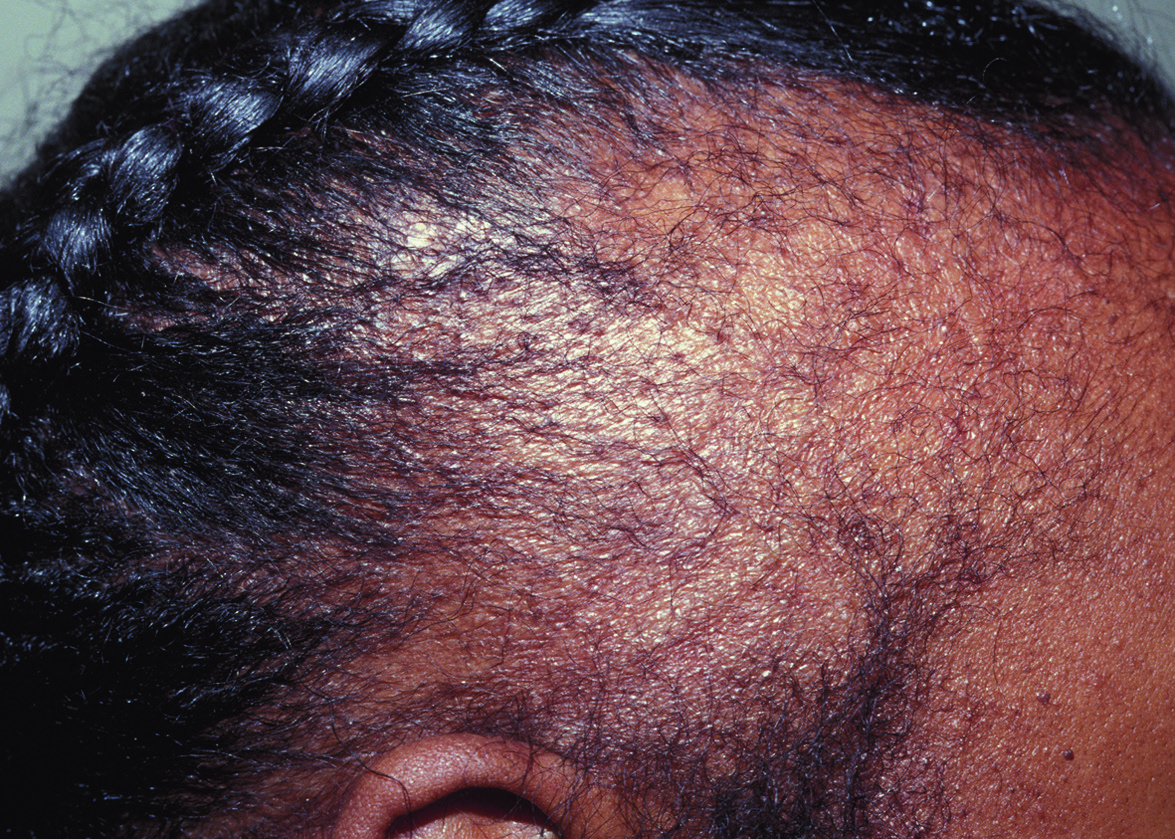
Fig. 69.16 Traction alopecia. Favors the frontotemporal area in African- American women and is due to traumatic types of hair styling. The arrow points to the “fringe sign”. Courtesy Leonard C. Sperling, MD.
Fig.69.16s.1433
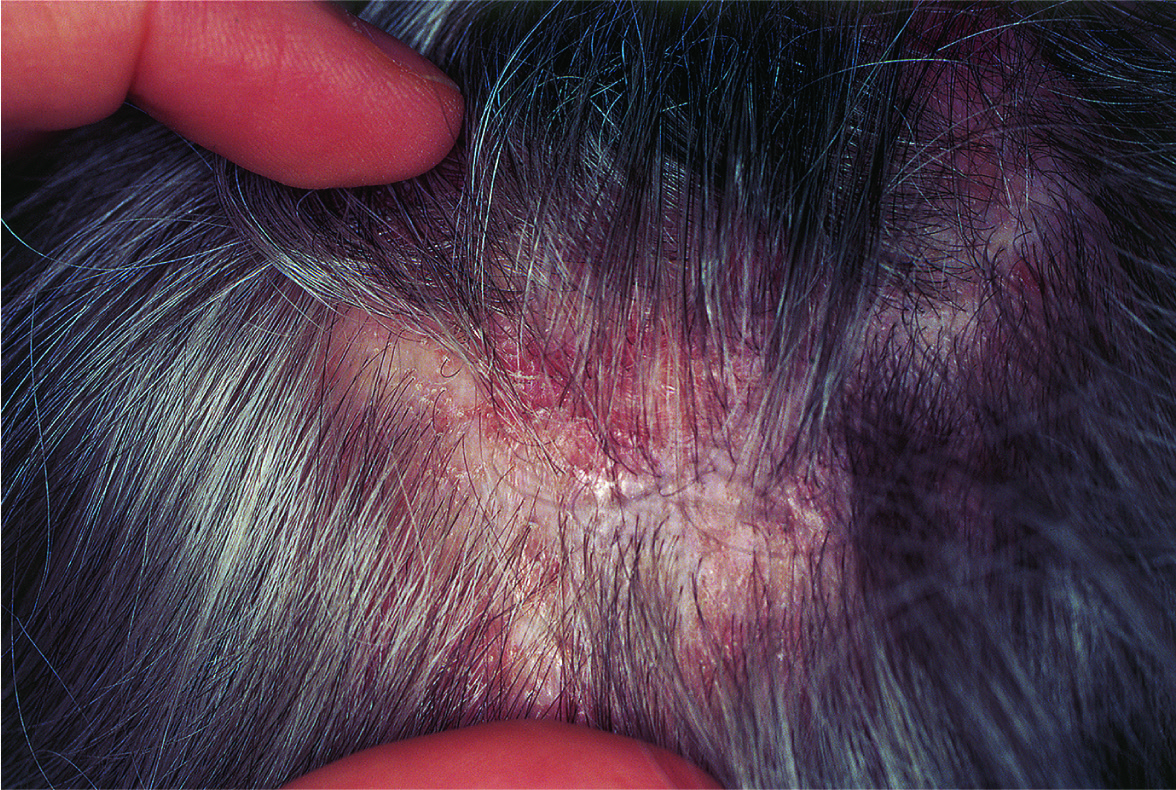
Fig. 69.17 Lichen planopilaris. A Patchy areas of alopecia with perifollicular erythema and scale at the active margins. B Later stage showing scarring with loss of follicular openings. By trichoscopy, there is perifollicular scaling and areas with no follicular openings (dots) due to loss of hair follicles (inset). A, Courtesy Jean L. Bolognia, MD.
Fig.69.17 As.1434
Fig. 69.17 Lichen planopilaris. A Patchy areas of alopecia with perifollicular erythema and scale at the active margins. B Later stage showing scarring with loss of follicular openings. By trichoscopy, there is perifollicular scaling and areas with no follicular openings (dots) due to loss of hair follicles (inset). A, Courtesy Jean L. Bolognia, MD.
Fig.69.17 Bs.1434
Fig. 69.17 Lichen planopilaris. A Patchy areas of alopecia with perifollicular erythema and scale at the active margins. B Later stage showing scarring with loss of follicular openings. By trichoscopy, there is perifollicular scaling and areas with no follicular openings (dots) due to loss of hair follicles (inset). A, Courtesy Jean L. Bolognia, MD.
Fig.69.17 Cs.1434
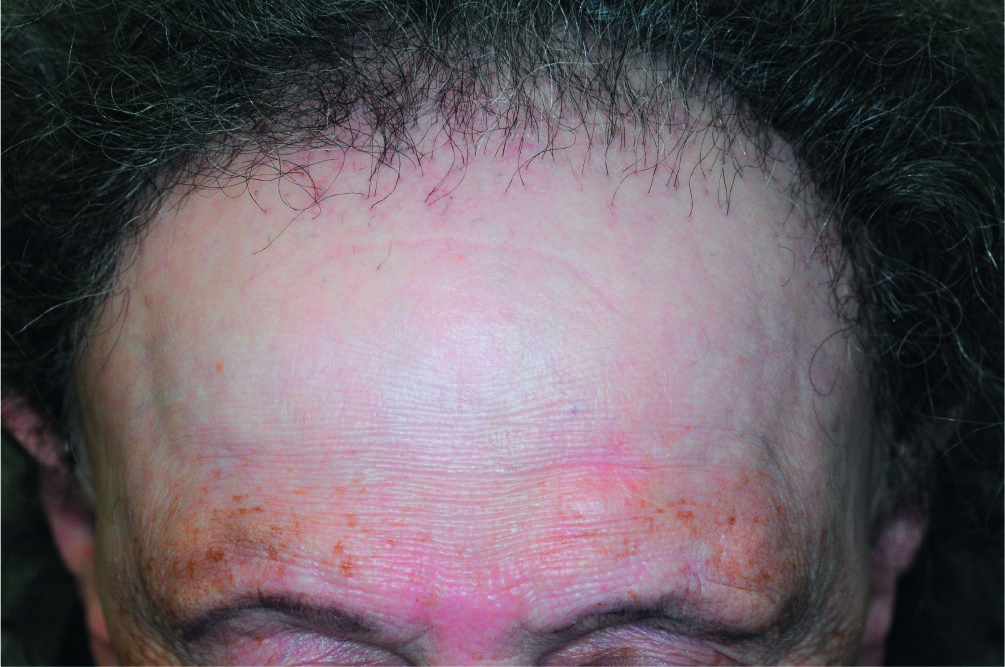
Fig. 69.18 Frontal fibrosing alopecia. A Progressive hair loss along the anterior hairline with absence of solar lentigines (diffuse pattern). There are scattered “lonely” hairs (inset) and an eyebrow pencil has been used because of loss of eyebrow hairs. B Hypopigmented, atrophic band of cicatricial alopecia with a clearly ­demarcated, receded hairline (linear pattern) in addition to a “pseudo- fringe”; the latter is a fringe of hairs that marks the previous hair line. C Facial papules and loss of eyebrows; the patient also has rosacea. D By trichoscopy, discrete perifollicular scaling around remaining hairs and beige areas with no follicular openings (dots). A, Courtesy Kalman Watsky, MD.
Fig.69.18 As.1435
Fig. 69.18 Frontal fibrosing alopecia. A Progressive hair loss along the anterior hairline with absence of solar lentigines (diffuse pattern). There are scattered “lonely” hairs (inset) and an eyebrow pencil has been used because of loss of eyebrow hairs. B Hypopigmented, atrophic band of cicatricial alopecia with a clearly ­demarcated, receded hairline (linear pattern) in addition to a “pseudo- fringe”; the latter is a fringe of hairs that marks the previous hair line. C Facial papules and loss of eyebrows; the patient also has rosacea. D By trichoscopy, discrete perifollicular scaling around remaining hairs and beige areas with no follicular openings (dots). A, Courtesy Kalman Watsky, MD.
Fig.69.18 Bs.1435
Fig. 69.18 Frontal fibrosing alopecia. A Progressive hair loss along the anterior hairline with absence of solar lentigines (diffuse pattern). There are scattered “lonely” hairs (inset) and an eyebrow pencil has been used because of loss of eyebrow hairs. B Hypopigmented, atrophic band of cicatricial alopecia with a clearly ­demarcated, receded hairline (linear pattern) in addition to a “pseudo- fringe”; the latter is a fringe of hairs that marks the previous hair line. C Facial papules and loss of eyebrows; the patient also has rosacea. D By trichoscopy, discrete perifollicular scaling around remaining hairs and beige areas with no follicular openings (dots). A, Courtesy Kalman Watsky, MD.
Fig.69.18 Cs.1435
Fig. 69.18 Frontal fibrosing alopecia. A Progressive hair loss along the anterior hairline with absence of solar lentigines (diffuse pattern). There are scattered “lonely” hairs (inset) and an eyebrow pencil has been used because of loss of eyebrow hairs. B Hypopigmented, atrophic band of cicatricial alopecia with a clearly ­demarcated, receded hairline (linear pattern) in addition to a “pseudo- fringe”; the latter is a fringe of hairs that marks the previous hair line. C Facial papules and loss of eyebrows; the patient also has rosacea. D By trichoscopy, discrete perifollicular scaling around remaining hairs and beige areas with no follicular openings (dots). A, Courtesy Kalman Watsky, MD.
Fig.69.18 Ds.1435
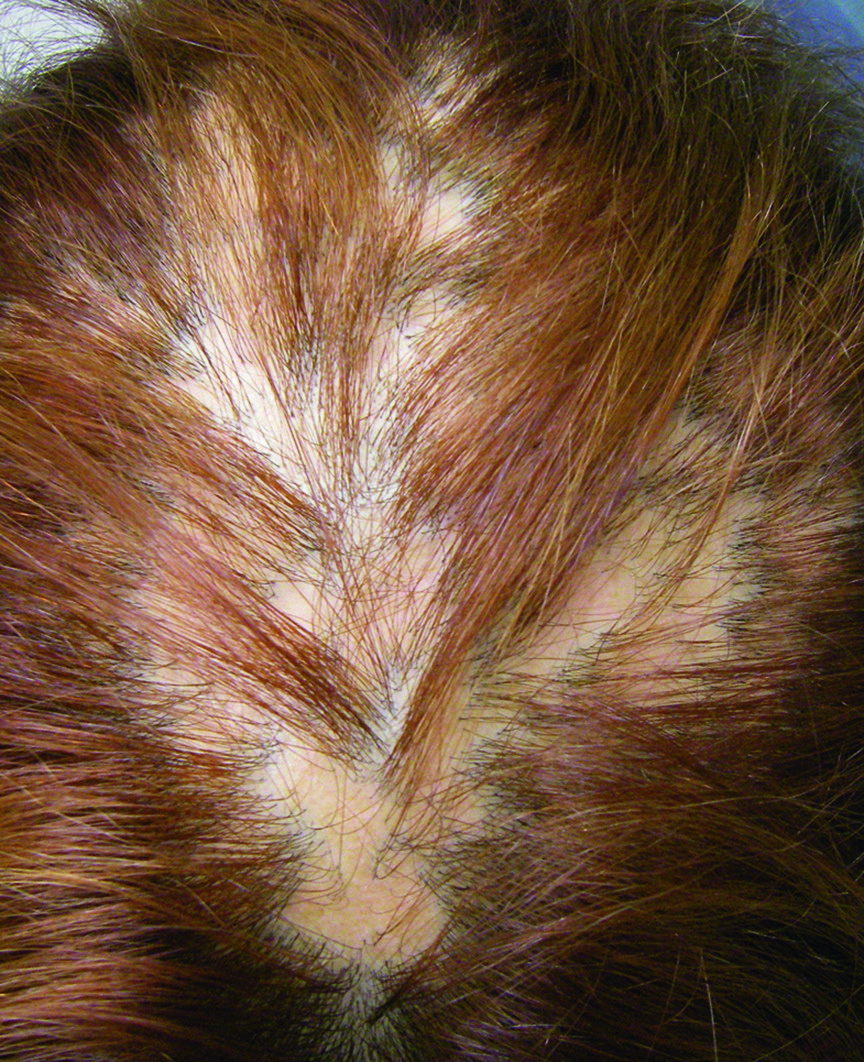
Fig. 69.19 Classic pseudopelade (pseudopelade of Brocq). Irregularly shaped areas of scarring alopecia along the midline. Despite no visible features of inflam- mation, the disease is usually progressive. Trichoscopy shows milky-red areas of cicatricial alopecia, sparse terminal hairs, and no features of inflam- mation (inset). Courtesy Kalman Watsky, MD.
Fig.69.19 As.1436
Fig. 69.19 Classic pseudopelade (pseudopelade of Brocq). Irregularly shaped areas of scarring alopecia along the midline. Despite no visible features of inflam- mation, the disease is usually progressive. Trichoscopy shows milky-red areas of cicatricial alopecia, sparse terminal hairs, and no features of inflam- mation (inset). Courtesy Kalman Watsky, MD.
Fig.69.19 Bs.1436
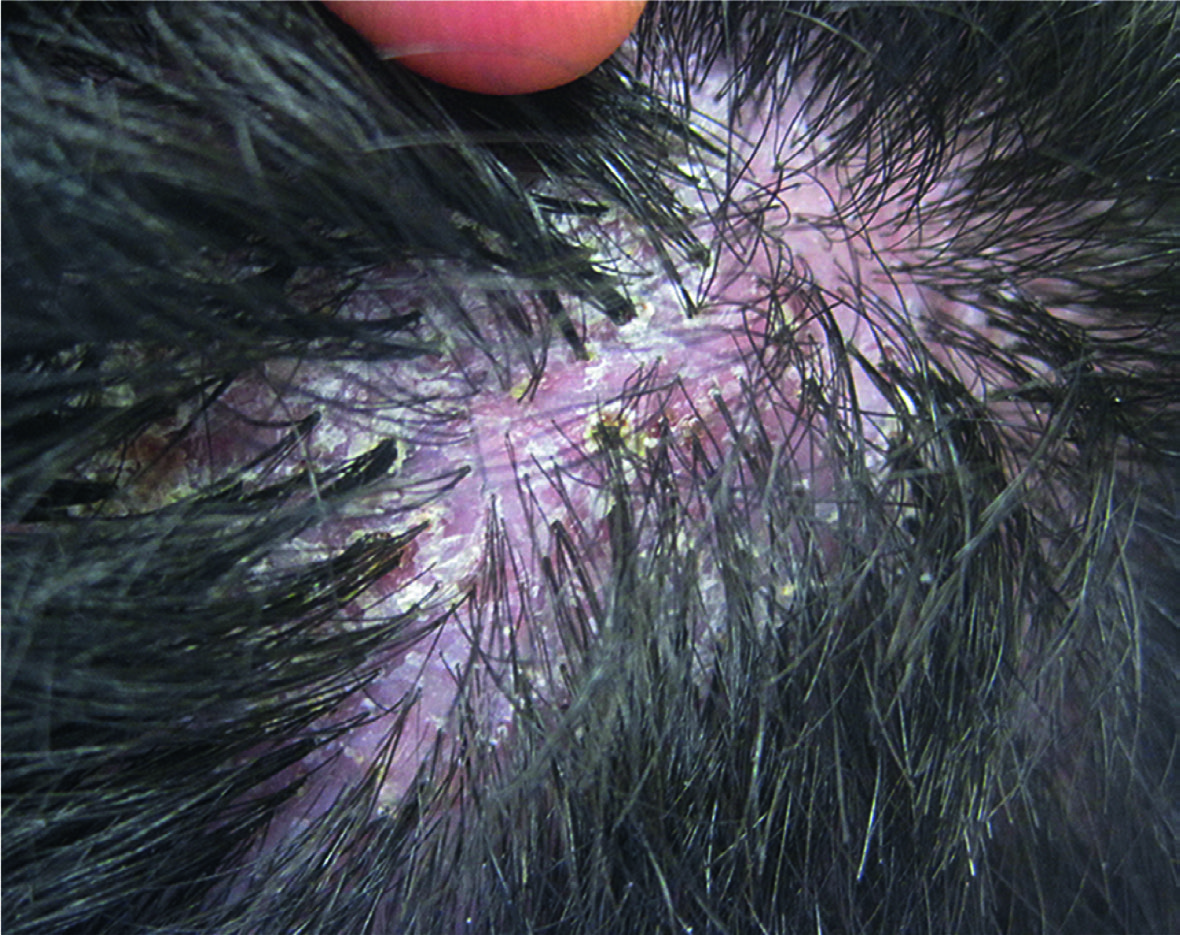
Fig. 69.21 Discoid lupus erythema- tosus. Coalescing areas of cicatricial alopecia in which there is obvious erythema. Central hypopigmentation is accompanied by peripheral hyper- pigmentation. Trichoscopy shows follicular plugs (large yellow dots) and arborizing vessels (inset). Courtesy Leonard C. Sperling, MD and Rodney D. Sinclair, MD.
Fig.69.21 As.1437
Fig. 69.21 Discoid lupus erythema- tosus. Coalescing areas of cicatricial alopecia in which there is obvious erythema. Central hypopigmentation is accompanied by peripheral hyper- pigmentation. Trichoscopy shows follicular plugs (large yellow dots) and arborizing vessels (inset). Courtesy Leonard C. Sperling, MD and Rodney D. Sinclair, MD.
Fig.69.21 Bs.1437
Fig. 69.21 Discoid lupus erythema- tosus. Coalescing areas of cicatricial alopecia in which there is obvious erythema. Central hypopigmentation is accompanied by peripheral hyper- pigmentation. Trichoscopy shows follicular plugs (large yellow dots) and arborizing vessels (inset). Courtesy Leonard C. Sperling, MD and Rodney D. Sinclair, MD.
Fig.69.21 Cs.1437
Fig. 69.22 Folliculitis decalvans. Note the multiple hairs arising from a single inflamed follicular orifice (“tufted folliculitis”) within the area of scarring alopecia. Trichoscopy shows hair tufts composed of multiple hairs and tubular perifollicular scaling (inset). Courtesy Damon McClain, MD.
Fig.69.22 As.1438
Fig. 69.22 Folliculitis decalvans. Note the multiple hairs arising from a single inflamed follicular orifice (“tufted folliculitis”) within the area of scarring alopecia. Trichoscopy shows hair tufts composed of multiple hairs and tubular perifollicular scaling (inset). Courtesy Damon McClain, MD.
Fig.69.22 Bs.1438
Fig. 69.23 Dissecting cellulitis. A Earlier stage with multiple ­interconnected, inflammatory, alopecic nodules admixed with pustules and crusts. By trichoscopy, there are 3D (“bubble”) black dots (inset). B Tender nodules with alopecia, draining sinuses, broad scarring, and linear scars. B, Courtesy Jeffrey P. Callen, MD.
Fig.69.23s.1439
Fig. 69.24 Hair shaft abnormalities. EM, electron microscopy. A, B, Courtesy Maria K. Hordinsky, MD; C–E, G, J, Courtesy Leonard C. Sperling, MD; F, Courtesy Jean L. Bolognia, MD.
Fig.69.24 As.1442
Fig. 69.24 Hair shaft abnormalities. EM, electron microscopy. A, B, Courtesy Maria K. Hordinsky, MD; C–E, G, J, Courtesy Leonard C. Sperling, MD; F, Courtesy Jean L. Bolognia, MD.
Fig.69.24 Bs.1442
Fig. 69.24 Hair shaft abnormalities. EM, electron microscopy. A, B, Courtesy Maria K. Hordinsky, MD; C–E, G, J, Courtesy Leonard C. Sperling, MD; F, Courtesy Jean L. Bolognia, MD.
Fig.69.24 Cs.1442
Fig. 69.24 Hair shaft abnormalities. EM, electron microscopy. A, B, Courtesy Maria K. Hordinsky, MD; C–E, G, J, Courtesy Leonard C. Sperling, MD; F, Courtesy Jean L. Bolognia, MD.
Fig.69.24 Ds.1442
Fig. 69.24 Hair shaft abnormalities. EM, electron microscopy. A, B, Courtesy Maria K. Hordinsky, MD; C–E, G, J, Courtesy Leonard C. Sperling, MD; F, Courtesy Jean L. Bolognia, MD.
Fig.69.24 Es.1442
Fig. 69.24 Hair shaft abnormalities. EM, electron microscopy. A, B, Courtesy Maria K. Hordinsky, MD; C–E, G, J, Courtesy Leonard C. Sperling, MD; F, Courtesy Jean L. Bolognia, MD.
Fig.69.24 Fs.1442
Fig. 69.25 Monilethrix. Fragility of the hair shafts leads to short broken hairs. Small perifollicular papules with scale are also present. By trichoscopy, the hair shafts have a beaded appearance (see Fig. 69.24C).
Fig.69.25 As.1443
Fig. 69.25 Monilethrix. Fragility of the hair shafts leads to short broken hairs. Small perifollicular papules with scale are also present. By trichoscopy, the hair shafts have a beaded appearance (see Fig. 69.24C).
Fig.69.25 Bs.1443