Bolognia 5e·Dermatoloji Çalışma Paneli
Ch 113

Melanom

Vol 2 · sayfa 2009 · §18
📖 Özet🃏 Flashcard Quiz🖼 Atlas
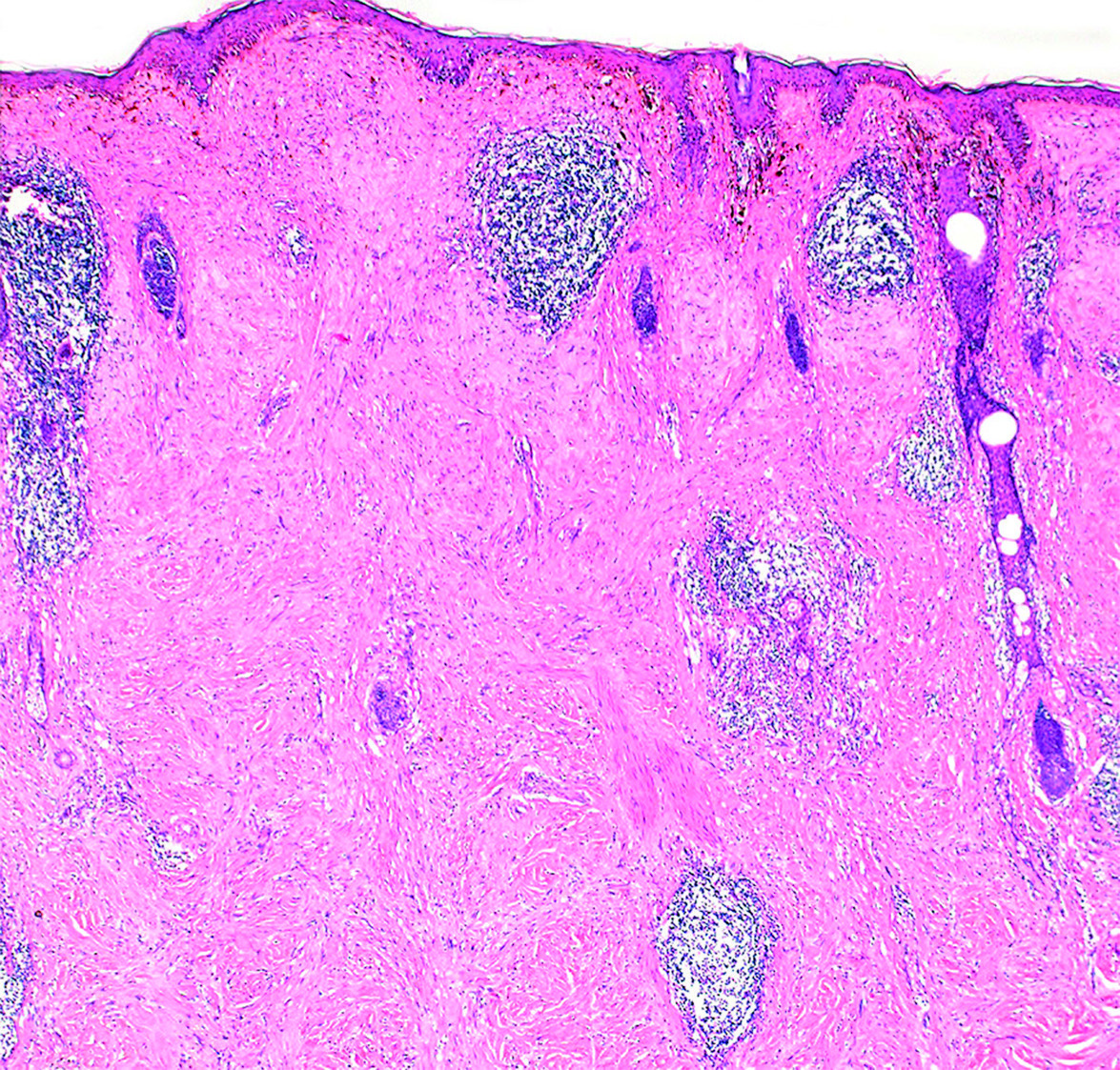
Fig. 113.2 Completely regressed cutaneous melanoma. A, B The gray-black arciform area had only melanophages in the upper dermis; although there were no remaining cells of melanoma, the patient already had nodal metas- tases. C The central hypopigmented area had fibrosis with sparse inflammation. Complexes of a pre-existing melanocytic nevus were present focally below the zone of regression. Courtesy, Department of Dermatology, Medical University of Graz.
Fig.113.2s.387
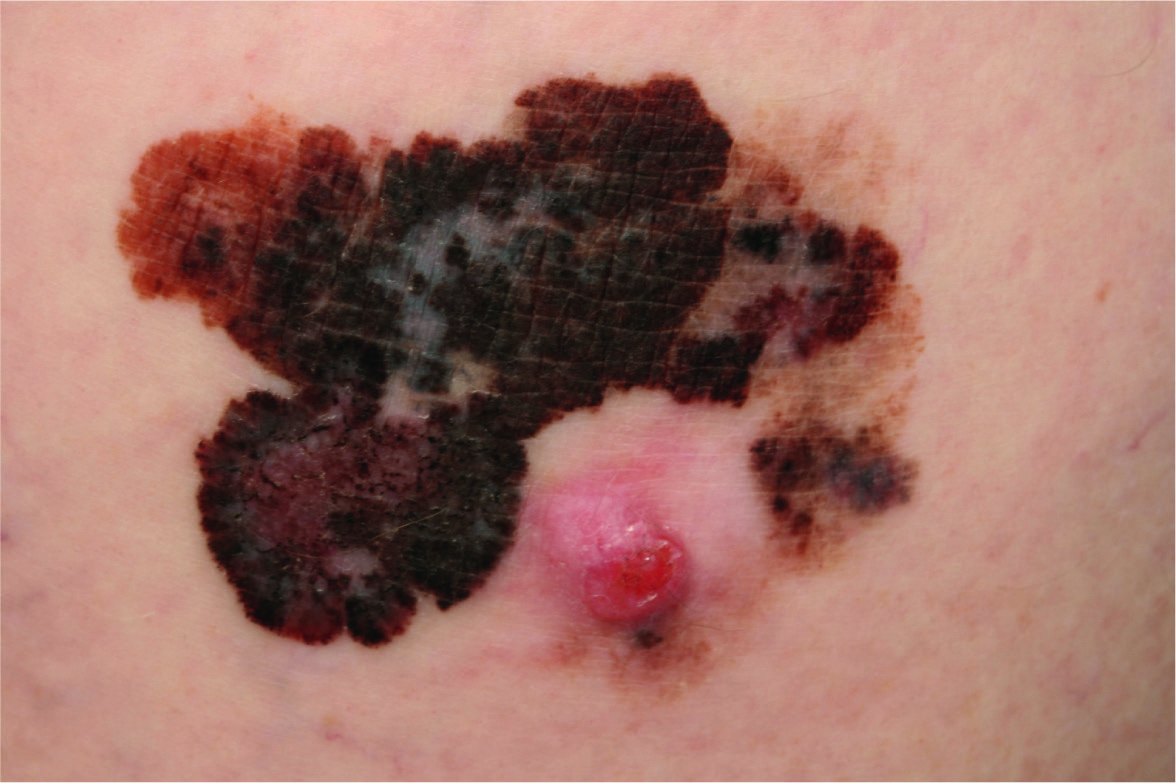
Fig. 113.7 Longstanding superficial spreading melanoma. Note asymmetry, irregular borders, variation in colors, scar-like regression zones, and an inferior pink papule, indicating vertical growth phase.
Fig.113.7s.392
Fig. 113.8 Superficial spreading melanomas. Clinically, all of these lesions demonstrate asymmetry due to variation in color and irregularity in outline. Breslow depths for A, C, E were <0.5 mm, 0.58 mm, and 1.60 mm, respectively. B, D, F By dermoscopy, there is asymmetry, atypical pigment networks, irregular blotches, and multiple colors; in D and F a blue–white veil is present. Courtesy Claus Garbe, MD and Jürgen Bauer, MD.
Fig.113.8 As.393
Fig. 113.8 Superficial spreading melanomas. Clinically, all of these lesions demonstrate asymmetry due to variation in color and irregularity in outline. Breslow depths for A, C, E were <0.5 mm, 0.58 mm, and 1.60 mm, respectively. B, D, F By dermoscopy, there is asymmetry, atypical pigment networks, irregular blotches, and multiple colors; in D and F a blue–white veil is present. Courtesy Claus Garbe, MD and Jürgen Bauer, MD.
Fig.113.8 Bs.393
Fig. 113.8 Superficial spreading melanomas. Clinically, all of these lesions demonstrate asymmetry due to variation in color and irregularity in outline. Breslow depths for A, C, E were <0.5 mm, 0.58 mm, and 1.60 mm, respectively. B, D, F By dermoscopy, there is asymmetry, atypical pigment networks, irregular blotches, and multiple colors; in D and F a blue–white veil is present. Courtesy Claus Garbe, MD and Jürgen Bauer, MD.
Fig.113.8 Cs.393
Fig. 113.8 Superficial spreading melanomas. Clinically, all of these lesions demonstrate asymmetry due to variation in color and irregularity in outline. Breslow depths for A, C, E were <0.5 mm, 0.58 mm, and 1.60 mm, respectively. B, D, F By dermoscopy, there is asymmetry, atypical pigment networks, irregular blotches, and multiple colors; in D and F a blue–white veil is present. Courtesy Claus Garbe, MD and Jürgen Bauer, MD.
Fig.113.8 Ds.393
Fig. 113.8 Superficial spreading melanomas. Clinically, all of these lesions demonstrate asymmetry due to variation in color and irregularity in outline. Breslow depths for A, C, E were <0.5 mm, 0.58 mm, and 1.60 mm, respectively. B, D, F By dermoscopy, there is asymmetry, atypical pigment networks, irregular blotches, and multiple colors; in D and F a blue–white veil is present. Courtesy Claus Garbe, MD and Jürgen Bauer, MD.
Fig.113.8 Es.393
Fig. 113.8 Superficial spreading melanomas. Clinically, all of these lesions demonstrate asymmetry due to variation in color and irregularity in outline. Breslow depths for A, C, E were <0.5 mm, 0.58 mm, and 1.60 mm, respectively. B, D, F By dermoscopy, there is asymmetry, atypical pigment networks, irregular blotches, and multiple colors; in D and F a blue–white veil is present. Courtesy Claus Garbe, MD and Jürgen Bauer, MD.
Fig.113.8 Fs.393
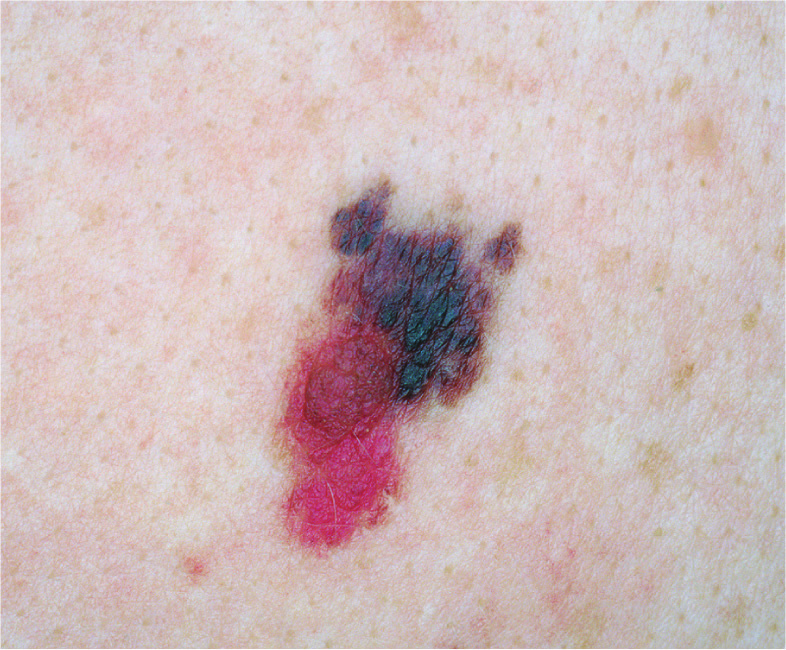
Fig. 113.9 Superficial spreading melanoma arising in a pre-existing melanocytic nevus. Note the irregular outline and variable pigmentation. The central brown papule represents the pre-existing melanocytic nevus; both the superior irregular brown-black plaque and the inferior erythematous plaque represent the melanoma.
Fig.113.9s.393
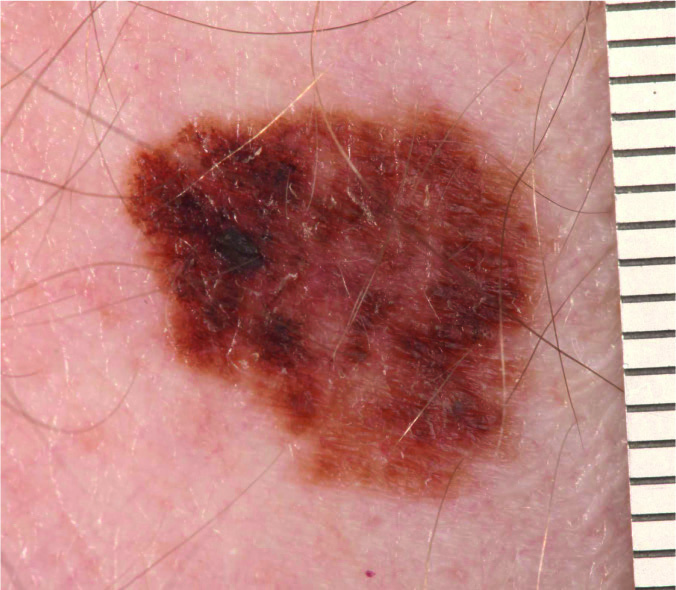
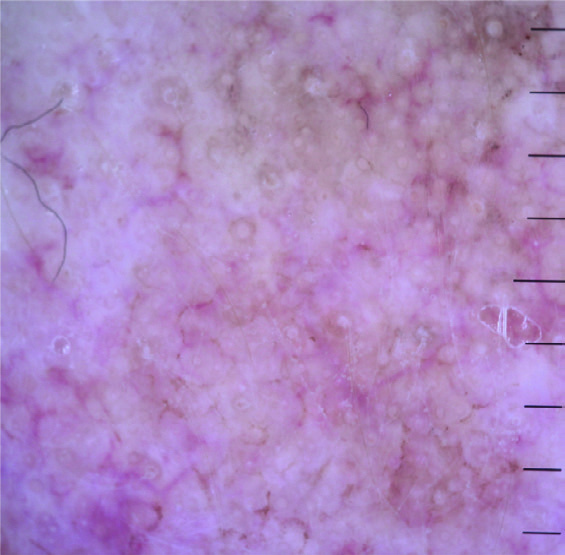
Fig. 113.10 Melanoma in situ on the dorsal foot of an 84-year-old man. A, B The lesion is asymmetric and not well circumscribed. C The dermoscopic findings include asymmetry, variation in color, atypical pigment network, and irregular brown blotches. Courtesy, Department of Dermatology, Medical University of Graz.
Fig.113.10s.393
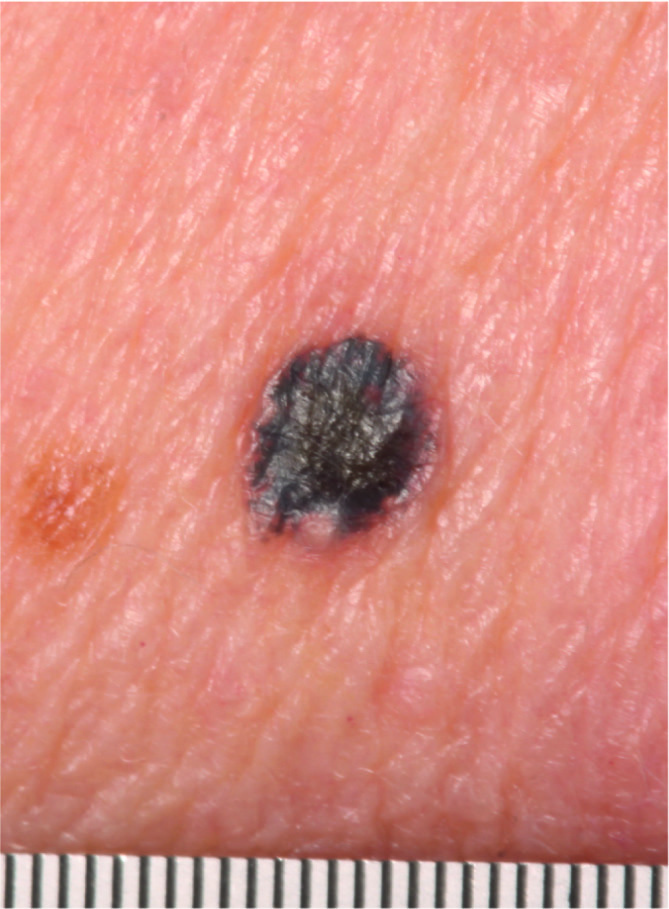
Fig. 113.11 Melanoma in situ. This melanoma in situ measured <3 mm in diameter. Small melanomas can be easily overlooked, especially if they are less heavily pigmented. This lesion was the “ugly duckling” (outlier) among this patient’s nevi. Dermoscopy assists in making an earlier diagnosis. Courtesy Claus Garbe, MD and Jürgen Bauer, MD.
Fig.113.11s.394
Fig. 113.12 Nodular melanomas. A Darkly pigmented papule measuring ~3 mm in diameter with a Breslow depth of 0.95 mm. B By dermoscopy, blue color, atypical pigment network, and streaks are seen. C Darkly pigmented plaque on the scalp with an eccentric nodule; Breslow depth was 2.75 mm. D By dermoscopy, multiple colors including blue–gray are seen. Courtesy Claus Garbe, MD and Jürgen Bauer, MD.
Fig.113.12 As.394
Fig. 113.12 Nodular melanomas. A Darkly pigmented papule measuring ~3 mm in diameter with a Breslow depth of 0.95 mm. B By dermoscopy, blue color, atypical pigment network, and streaks are seen. C Darkly pigmented plaque on the scalp with an eccentric nodule; Breslow depth was 2.75 mm. D By dermoscopy, multiple colors including blue–gray are seen. Courtesy Claus Garbe, MD and Jürgen Bauer, MD.
Fig.113.12 Bs.394
Fig. 113.12 Nodular melanomas. A Darkly pigmented papule measuring ~3 mm in diameter with a Breslow depth of 0.95 mm. B By dermoscopy, blue color, atypical pigment network, and streaks are seen. C Darkly pigmented plaque on the scalp with an eccentric nodule; Breslow depth was 2.75 mm. D By dermoscopy, multiple colors including blue–gray are seen. Courtesy Claus Garbe, MD and Jürgen Bauer, MD.
Fig.113.12 Cs.394
Fig. 113.12 Nodular melanomas. A Darkly pigmented papule measuring ~3 mm in diameter with a Breslow depth of 0.95 mm. B By dermoscopy, blue color, atypical pigment network, and streaks are seen. C Darkly pigmented plaque on the scalp with an eccentric nodule; Breslow depth was 2.75 mm. D By dermoscopy, multiple colors including blue–gray are seen. Courtesy Claus Garbe, MD and Jürgen Bauer, MD.
Fig.113.12 Ds.394
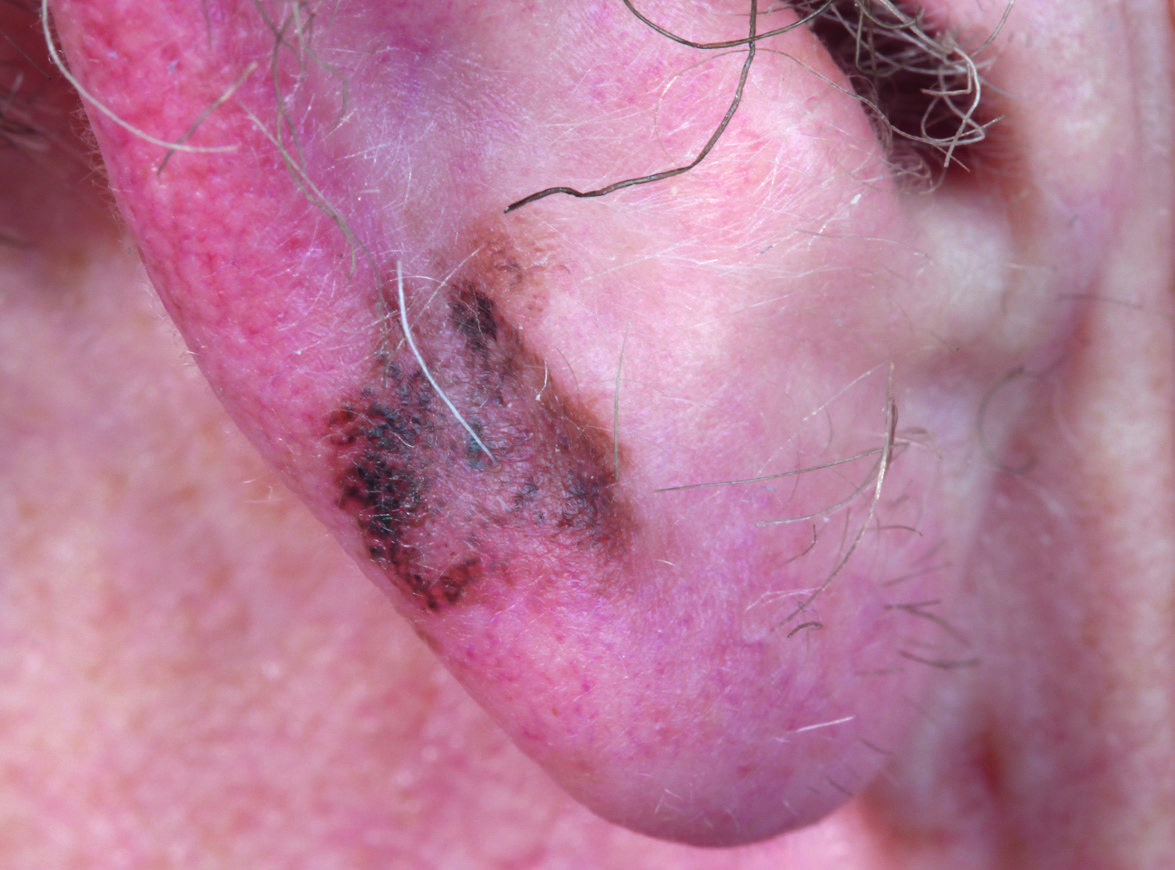
Fig. 113.13 Lentigo maligna melanoma. A Asymmetric pigmented lesion on the earlobe, with irregular borders and significant variation in pigmentation; the Breslow depth was 0.45 mm. B Larger triangular brown patch in which there are multiple dark brown, black, and blue–gray papules and plaques. Breslow depth was 1.1 mm. A, Courtesy Claus Garbe, MD and Jürgen Bauer, MD; B, Courtesy Kalman Watsky, MD.
Fig.113.13 As.394
Fig. 113.13 Lentigo maligna melanoma. A Asymmetric pigmented lesion on the earlobe, with irregular borders and significant variation in pigmentation; the Breslow depth was 0.45 mm. B Larger triangular brown patch in which there are multiple dark brown, black, and blue–gray papules and plaques. Breslow depth was 1.1 mm. A, Courtesy Claus Garbe, MD and Jürgen Bauer, MD; B, Courtesy Kalman Watsky, MD.
Fig.113.13 Bs.394
Fig. 113.14 Lentigo maligna (melanoma in situ, lentigo maligna type). A, C An early lentigo maligna presenting as a light brown patch with subtle, asymmetric pigmentation is compared to a more obvious lesion with readily apparent variation in pigmentation. B, D By dermoscopy, follicular openings surrounded by annular pigmentation are seen, referred to as a “circle in a circle”. Findings are more subtle in B and a few rhomboidal structures are seen in D. E A pigmented lesion on the dorsal nose, with irregular borders, light to dark brown color, and marked asymmetry. F Dermoscopy demonstrating annular structures corre- sponding to follicular openings surrounded by melanoma cells (“circle in a circle”). Courtesy Claus Garbe, MD and Jürgen Bauer, MD.
Fig.113.14 As.395
Fig. 113.14 Lentigo maligna (melanoma in situ, lentigo maligna type). A, C An early lentigo maligna presenting as a light brown patch with subtle, asymmetric pigmentation is compared to a more obvious lesion with readily apparent variation in pigmentation. B, D By dermoscopy, follicular openings surrounded by annular pigmentation are seen, referred to as a “circle in a circle”. Findings are more subtle in B and a few rhomboidal structures are seen in D. E A pigmented lesion on the dorsal nose, with irregular borders, light to dark brown color, and marked asymmetry. F Dermoscopy demonstrating annular structures corre- sponding to follicular openings surrounded by melanoma cells (“circle in a circle”). Courtesy Claus Garbe, MD and Jürgen Bauer, MD.
Fig.113.14 Bs.395
Fig. 113.14 Lentigo maligna (melanoma in situ, lentigo maligna type). A, C An early lentigo maligna presenting as a light brown patch with subtle, asymmetric pigmentation is compared to a more obvious lesion with readily apparent variation in pigmentation. B, D By dermoscopy, follicular openings surrounded by annular pigmentation are seen, referred to as a “circle in a circle”. Findings are more subtle in B and a few rhomboidal structures are seen in D. E A pigmented lesion on the dorsal nose, with irregular borders, light to dark brown color, and marked asymmetry. F Dermoscopy demonstrating annular structures corre- sponding to follicular openings surrounded by melanoma cells (“circle in a circle”). Courtesy Claus Garbe, MD and Jürgen Bauer, MD.
Fig.113.14 Cs.395
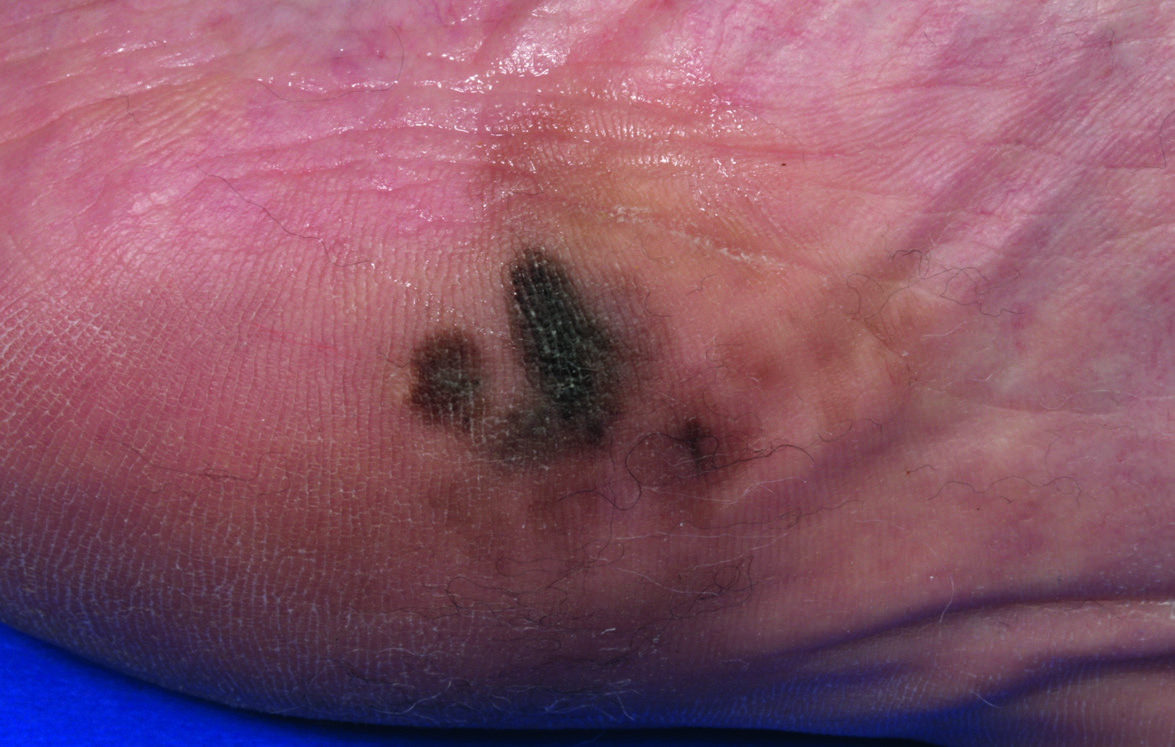
Fig. 113.15 Acral lentiginous melanoma. A Irregularly pigmented lesion on the plantar surface of the foot. Dermoscopic findings include irregular diffuse pigmentation and a parallel ridge pattern (see Fig. 112.14). B Crusted pink nodule on the heel that had been treated for several months as a wart prior to diagnosis. A, Courtesy Claus Garbe, MD and Jürgen Bauer, MD; B, Courtesy Department of Dermatology, Medical University of Graz.
Fig.113.15 As.396
Fig. 113.15 Acral lentiginous melanoma. A Irregularly pigmented lesion on the plantar surface of the foot. Dermoscopic findings include irregular diffuse pigmentation and a parallel ridge pattern (see Fig. 112.14). B Crusted pink nodule on the heel that had been treated for several months as a wart prior to diagnosis. A, Courtesy Claus Garbe, MD and Jürgen Bauer, MD; B, Courtesy Department of Dermatology, Medical University of Graz.
Fig.113.15 Bs.396
Fig. 113.16 Melanoma of the nail matrix. A, B The longitudinal pigmentation of the nail plate is non-homogeneous, both clinically and dermoscopically. Histologically, the Breslow depth was 0.7 mm. Courtesy Claus Garbe, MD and Jürgen Bauer, MD.
Fig.113.16 As.396
Fig. 113.16 Melanoma of the nail matrix. A, B The longitudinal pigmentation of the nail plate is non-homogeneous, both clinically and dermoscopically. Histologically, the Breslow depth was 0.7 mm. Courtesy Claus Garbe, MD and Jürgen Bauer, MD.
Fig.113.16 Bs.396
Fig. 113.17 Amelanotic melanoma. A, B Skin-colored to light pink nodule on the right scapula of a female patient; tumor thickness was 4 mm. C By dermoscopy, some pigmented globules allow one to identify the tumor as a melanocytic lesion. Dotted, point, and linear-irregular vessels are suggestive of melanoma. Courtesy Claus Garbe, MD and Jürgen Bauer, MD.
Fig.113.17s.396
Fig. 113.19 Melanoma arising in a cellular blue nevus (blue nevus-like melanoma). Satellite (lymphatic) metastases are also present. Courtesy Helmut Kerl, MD.
Fig.113.19 As.397
Fig. 113.19 Melanoma arising in a cellular blue nevus (blue nevus-like melanoma). Satellite (lymphatic) metastases are also present. Courtesy Helmut Kerl, MD.
Fig.113.19 Bs.397
Fig. 113.19 Melanoma arising in a cellular blue nevus (blue nevus-like melanoma). Satellite (lymphatic) metastases are also present. Courtesy Helmut Kerl, MD.
Fig.113.19 Cs.397
Fig. 113.26 Microstaging of cutaneous melanoma: Breslow tumor thickness. Breslow method: measure from the granular layer of the epidermis to the deepest part of the tumor.
Fig.113.26s.403
Fig. 113.28 Local recurrences of cutaneous melanoma. A Persistent disease-type local recurrence of lentigo maligna (melanoma in situ) along the upper lateral margin of the excision of the chin; inked lesion on the central upper lip is an actinic keratosis. B Recurrent in situ acral lentiginous melanoma at the 10 o’clock position on the split-thickness skin graft. C Recurrent acral lentiginous melanoma on the second finger. The lentiginous types of melanoma have a propensity to recur locally due to persistence of subclinical melanoma (mainly in situ) as well as the presence of “field melanocytes” that harbor the same genetic alterations as the primary tumor but are morphologically indistinguishable from normal melanocytes, thus leading to “false negative” histologic margins. Staining with PRAME may highlight positive nevoid melanocytes at the site of the tumor, possibly reducing the risk of recurrence, but data are still very limited. D Amelanotic nodule representing local recurrence of a desmoplastic melanoma under the skin graft. A,B,D, Courtesy Jean L. Bolognia, MD; C, Courtesy Department of Dermatology, Medical University of Graz.
Fig.113.28 As.412
Fig. 113.28 Local recurrences of cutaneous melanoma. A Persistent disease-type local recurrence of lentigo maligna (melanoma in situ) along the upper lateral margin of the excision of the chin; inked lesion on the central upper lip is an actinic keratosis. B Recurrent in situ acral lentiginous melanoma at the 10 o’clock position on the split-thickness skin graft. C Recurrent acral lentiginous melanoma on the second finger. The lentiginous types of melanoma have a propensity to recur locally due to persistence of subclinical melanoma (mainly in situ) as well as the presence of “field melanocytes” that harbor the same genetic alterations as the primary tumor but are morphologically indistinguishable from normal melanocytes, thus leading to “false negative” histologic margins. Staining with PRAME may highlight positive nevoid melanocytes at the site of the tumor, possibly reducing the risk of recurrence, but data are still very limited. D Amelanotic nodule representing local recurrence of a desmoplastic melanoma under the skin graft. A,B,D, Courtesy Jean L. Bolognia, MD; C, Courtesy Department of Dermatology, Medical University of Graz.
Fig.113.28 Bs.412
Fig. 113.28 Local recurrences of cutaneous melanoma. A Persistent disease-type local recurrence of lentigo maligna (melanoma in situ) along the upper lateral margin of the excision of the chin; inked lesion on the central upper lip is an actinic keratosis. B Recurrent in situ acral lentiginous melanoma at the 10 o’clock position on the split-thickness skin graft. C Recurrent acral lentiginous melanoma on the second finger. The lentiginous types of melanoma have a propensity to recur locally due to persistence of subclinical melanoma (mainly in situ) as well as the presence of “field melanocytes” that harbor the same genetic alterations as the primary tumor but are morphologically indistinguishable from normal melanocytes, thus leading to “false negative” histologic margins. Staining with PRAME may highlight positive nevoid melanocytes at the site of the tumor, possibly reducing the risk of recurrence, but data are still very limited. D Amelanotic nodule representing local recurrence of a desmoplastic melanoma under the skin graft. A,B,D, Courtesy Jean L. Bolognia, MD; C, Courtesy Department of Dermatology, Medical University of Graz.
Fig.113.28 Cs.412
Fig. 113.28 Local recurrences of cutaneous melanoma. A Persistent disease-type local recurrence of lentigo maligna (melanoma in situ) along the upper lateral margin of the excision of the chin; inked lesion on the central upper lip is an actinic keratosis. B Recurrent in situ acral lentiginous melanoma at the 10 o’clock position on the split-thickness skin graft. C Recurrent acral lentiginous melanoma on the second finger. The lentiginous types of melanoma have a propensity to recur locally due to persistence of subclinical melanoma (mainly in situ) as well as the presence of “field melanocytes” that harbor the same genetic alterations as the primary tumor but are morphologically indistinguishable from normal melanocytes, thus leading to “false negative” histologic margins. Staining with PRAME may highlight positive nevoid melanocytes at the site of the tumor, possibly reducing the risk of recurrence, but data are still very limited. D Amelanotic nodule representing local recurrence of a desmoplastic melanoma under the skin graft. A,B,D, Courtesy Jean L. Bolognia, MD; C, Courtesy Department of Dermatology, Medical University of Graz.
Fig.113.28 Ds.412
Fig. 113.29 Satellite and in-transit (lymphatic) metastases of cutaneous melanoma. A Amelanotic melanoma of the external ear with satellitosis. B Ulcerated melanoma of the hallux with multiple in-transit metastases on the shin and calf, consisting of numerous brown to gray-black patches, papules, and small plaques. C In-transit metastases consisting of multiple firm pink papules on the leg. D In-transit metastases consisting of multiple friable tumors on the arm as well as smaller blue–gray papules. A, Courtesy Sonya K. Burton, MD; C, Courtesy, Department of Dermatology, Medical University of Graz; D, Courtesy Edward Cowen, MD.
Fig.113.29 As.412
Fig. 113.29 Satellite and in-transit (lymphatic) metastases of cutaneous melanoma. A Amelanotic melanoma of the external ear with satellitosis. B Ulcerated melanoma of the hallux with multiple in-transit metastases on the shin and calf, consisting of numerous brown to gray-black patches, papules, and small plaques. C In-transit metastases consisting of multiple firm pink papules on the leg. D In-transit metastases consisting of multiple friable tumors on the arm as well as smaller blue–gray papules. A, Courtesy Sonya K. Burton, MD; C, Courtesy, Department of Dermatology, Medical University of Graz; D, Courtesy Edward Cowen, MD.
Fig.113.29 Bs.412
Fig. 113.29 Satellite and in-transit (lymphatic) metastases of cutaneous melanoma. A Amelanotic melanoma of the external ear with satellitosis. B Ulcerated melanoma of the hallux with multiple in-transit metastases on the shin and calf, consisting of numerous brown to gray-black patches, papules, and small plaques. C In-transit metastases consisting of multiple firm pink papules on the leg. D In-transit metastases consisting of multiple friable tumors on the arm as well as smaller blue–gray papules. A, Courtesy Sonya K. Burton, MD; C, Courtesy, Department of Dermatology, Medical University of Graz; D, Courtesy Edward Cowen, MD.
Fig.113.29 Cs.412
Fig. 113.29 Satellite and in-transit (lymphatic) metastases of cutaneous melanoma. A Amelanotic melanoma of the external ear with satellitosis. B Ulcerated melanoma of the hallux with multiple in-transit metastases on the shin and calf, consisting of numerous brown to gray-black patches, papules, and small plaques. C In-transit metastases consisting of multiple firm pink papules on the leg. D In-transit metastases consisting of multiple friable tumors on the arm as well as smaller blue–gray papules. A, Courtesy Sonya K. Burton, MD; C, Courtesy, Department of Dermatology, Medical University of Graz; D, Courtesy Edward Cowen, MD.
Fig.113.29 Ds.412
Fig. 113.30 Local recurrences of cutaneous melanoma. A Recurrent lentigo maligna on the lower leg; note the depressed scar due to repeated excisions. B By dermoscopy, an asymmetric pattern with multiple colors, ranging from light brown to dark blue–gray. C Recurrent acral lentiginous melanoma of the nail unit. The lentiginous types of melanoma have a propensity to recur locally due to persis- tence of subclinical melanoma (mainly in situ and/or in radial growth phase). D By dermoscopy, an asymmetric pattern with an atypical network inferiorly and multiple colors including blue–gray and gray–white. Courtesy Claus Garbe, MD and Jürgen Bauer, MD.
Fig.113.30 As.413
Fig. 113.30 Local recurrences of cutaneous melanoma. A Recurrent lentigo maligna on the lower leg; note the depressed scar due to repeated excisions. B By dermoscopy, an asymmetric pattern with multiple colors, ranging from light brown to dark blue–gray. C Recurrent acral lentiginous melanoma of the nail unit. The lentiginous types of melanoma have a propensity to recur locally due to persis- tence of subclinical melanoma (mainly in situ and/or in radial growth phase). D By dermoscopy, an asymmetric pattern with an atypical network inferiorly and multiple colors including blue–gray and gray–white. Courtesy Claus Garbe, MD and Jürgen Bauer, MD.
Fig.113.30 Bs.413
Fig. 113.30 Local recurrences of cutaneous melanoma. A Recurrent lentigo maligna on the lower leg; note the depressed scar due to repeated excisions. B By dermoscopy, an asymmetric pattern with multiple colors, ranging from light brown to dark blue–gray. C Recurrent acral lentiginous melanoma of the nail unit. The lentiginous types of melanoma have a propensity to recur locally due to persis- tence of subclinical melanoma (mainly in situ and/or in radial growth phase). D By dermoscopy, an asymmetric pattern with an atypical network inferiorly and multiple colors including blue–gray and gray–white. Courtesy Claus Garbe, MD and Jürgen Bauer, MD.
Fig.113.30 Cs.413
Fig. 113.30 Local recurrences of cutaneous melanoma. A Recurrent lentigo maligna on the lower leg; note the depressed scar due to repeated excisions. B By dermoscopy, an asymmetric pattern with multiple colors, ranging from light brown to dark blue–gray. C Recurrent acral lentiginous melanoma of the nail unit. The lentiginous types of melanoma have a propensity to recur locally due to persis- tence of subclinical melanoma (mainly in situ and/or in radial growth phase). D By dermoscopy, an asymmetric pattern with an atypical network inferiorly and multiple colors including blue–gray and gray–white. Courtesy Claus Garbe, MD and Jürgen Bauer, MD.
Fig.113.30 Ds.413