Bolognia 5e·Dermatoloji Çalışma Paneli
Ch 108

AK, BCC ve SCC

Vol 2 · sayfa 1888 · §18
📖 Özet🃏 Flashcard Quiz🖼 Atlas
Fig. 108.1 Basal cell nevus syndrome. A Numerous small and several large nodular BCCs on the face. B Multiple palmar pits. B, Courtesy Jeffrey P. Callen, MD.
Fig.108.1 As.241
Fig. 108.1 Basal cell nevus syndrome. A Numerous small and several large nodular BCCs on the face. B Multiple palmar pits. B, Courtesy Jeffrey P. Callen, MD.
Fig.108.1 Bs.241
Fig. 108.2 Actinic keratoses (AKs). A Multiple AKs on the forehead of an elderly woman with fair complexion, blue eyes, and severe photo- damage; the AKs vary in size from a few millimeters to over a centimeter. On the left forehead, the eroded pink plaque with scale represents a superficial SCC. B Pink-colored atrophic AK with minimal scale on the forehead. C Multiple AKs on the bald scalp, some of which are hyperkeratotic; the area of hypopigmentation represents a site of previous treatment and due to the field defect, recurrence at the edge is commonly observed. D Multiple, large hyper- trophic AKs on the shin of an elderly woman; note the thick scale. A, Courtesy, Medical University of Graz; B, Courtesy Iris Zalaudek, MD; D, Courtesy Jean L. Bolognia, MD.
Fig.108.2 As.242
Fig. 108.2 Actinic keratoses (AKs). A Multiple AKs on the forehead of an elderly woman with fair complexion, blue eyes, and severe photo- damage; the AKs vary in size from a few millimeters to over a centimeter. On the left forehead, the eroded pink plaque with scale represents a superficial SCC. B Pink-colored atrophic AK with minimal scale on the forehead. C Multiple AKs on the bald scalp, some of which are hyperkeratotic; the area of hypopigmentation represents a site of previous treatment and due to the field defect, recurrence at the edge is commonly observed. D Multiple, large hyper- trophic AKs on the shin of an elderly woman; note the thick scale. A, Courtesy, Medical University of Graz; B, Courtesy Iris Zalaudek, MD; D, Courtesy Jean L. Bolognia, MD.
Fig.108.2 Bs.242
Fig. 108.2 Actinic keratoses (AKs). A Multiple AKs on the forehead of an elderly woman with fair complexion, blue eyes, and severe photo- damage; the AKs vary in size from a few millimeters to over a centimeter. On the left forehead, the eroded pink plaque with scale represents a superficial SCC. B Pink-colored atrophic AK with minimal scale on the forehead. C Multiple AKs on the bald scalp, some of which are hyperkeratotic; the area of hypopigmentation represents a site of previous treatment and due to the field defect, recurrence at the edge is commonly observed. D Multiple, large hyper- trophic AKs on the shin of an elderly woman; note the thick scale. A, Courtesy, Medical University of Graz; B, Courtesy Iris Zalaudek, MD; D, Courtesy Jean L. Bolognia, MD.
Fig.108.2 Cs.242
Fig. 108.3 Pigmented actinic keratoses. A, B The hyperpigmentation can have a reticulated appearance and there may be associated scale but an absence of erythema. Courtesy Kalman Watsky, MD.
Fig.108.3 As.243
Fig. 108.3 Pigmented actinic keratoses. A, B The hyperpigmentation can have a reticulated appearance and there may be associated scale but an absence of erythema. Courtesy Kalman Watsky, MD.
Fig.108.3 Bs.243
Fig. 108.3 Pigmented actinic keratoses. A, B The hyperpigmentation can have a reticulated appearance and there may be associated scale but an absence of erythema. Courtesy Kalman Watsky, MD.
Fig.108.3 Cs.243
Fig. 108.4 Actinic cheilitis. Erythema and scale of the entire lower vermilion lip with erosions and areas of leukoplakia. Courtesy Kalman Watsky, MD.
Fig.108.4 As.243
Fig. 108.4 Actinic cheilitis. Erythema and scale of the entire lower vermilion lip with erosions and areas of leukoplakia. Courtesy Kalman Watsky, MD.
Fig.108.4 Bs.243
Fig. 108.5 Squamous cell carcinomas in situ, Bowen disease type. A Scaly red plaque on the chest with skip areas and background photodamage. B Erythematous plaque with thick yellow scale-crust on the distal lower extremity that may be misdiagnosed as psoriasis or dermatitis. C Larger broken-up pink plaque with scale- crust in the pubic region, a sun-protected site. This type of lesion is often misdiagnosed as dermatitis or psoriasis and treated with topical corticosteroids. D Bright red, well-demarcated plaque on the proximal nail fold with associated horizontal nail ridging; the possibility of HPV infection needs to be considered. E Dermoscopic findings of tiny dotted vessels in the upper half of the lesion combined with superficial scales. F Extensive involvement of the finger which was misdiagnosed clini- cally as an inflammatory dermatosis and treated for years with corticosteroid creams. B, Courtesy Kalman Watsky, MD; E, Courtesy Iris Zalaudek, MD.
Fig.108.5 As.243
Fig. 108.5 Squamous cell carcinomas in situ, Bowen disease type. A Scaly red plaque on the chest with skip areas and background photodamage. B Erythematous plaque with thick yellow scale-crust on the distal lower extremity that may be misdiagnosed as psoriasis or dermatitis. C Larger broken-up pink plaque with scale- crust in the pubic region, a sun-protected site. This type of lesion is often misdiagnosed as dermatitis or psoriasis and treated with topical corticosteroids. D Bright red, well-demarcated plaque on the proximal nail fold with associated horizontal nail ridging; the possibility of HPV infection needs to be considered. E Dermoscopic findings of tiny dotted vessels in the upper half of the lesion combined with superficial scales. F Extensive involvement of the finger which was misdiagnosed clini- cally as an inflammatory dermatosis and treated for years with corticosteroid creams. B, Courtesy Kalman Watsky, MD; E, Courtesy Iris Zalaudek, MD.
Fig.108.5 Bs.243
Fig. 108.5 Squamous cell carcinomas in situ, Bowen disease type. A Scaly red plaque on the chest with skip areas and background photodamage. B Erythematous plaque with thick yellow scale-crust on the distal lower extremity that may be misdiagnosed as psoriasis or dermatitis. C Larger broken-up pink plaque with scale- crust in the pubic region, a sun-protected site. This type of lesion is often misdiagnosed as dermatitis or psoriasis and treated with topical corticosteroids. D Bright red, well-demarcated plaque on the proximal nail fold with associated horizontal nail ridging; the possibility of HPV infection needs to be considered. E Dermoscopic findings of tiny dotted vessels in the upper half of the lesion combined with superficial scales. F Extensive involvement of the finger which was misdiagnosed clini- cally as an inflammatory dermatosis and treated for years with corticosteroid creams. B, Courtesy Kalman Watsky, MD; E, Courtesy Iris Zalaudek, MD.
Fig.108.5 Cs.243
Fig. 108.5 Squamous cell carcinomas in situ, Bowen disease type. A Scaly red plaque on the chest with skip areas and background photodamage. B Erythematous plaque with thick yellow scale-crust on the distal lower extremity that may be misdiagnosed as psoriasis or dermatitis. C Larger broken-up pink plaque with scale- crust in the pubic region, a sun-protected site. This type of lesion is often misdiagnosed as dermatitis or psoriasis and treated with topical corticosteroids. D Bright red, well-demarcated plaque on the proximal nail fold with associated horizontal nail ridging; the possibility of HPV infection needs to be considered. E Dermoscopic findings of tiny dotted vessels in the upper half of the lesion combined with superficial scales. F Extensive involvement of the finger which was misdiagnosed clini- cally as an inflammatory dermatosis and treated for years with corticosteroid creams. B, Courtesy Kalman Watsky, MD; E, Courtesy Iris Zalaudek, MD.
Fig.108.5 Ds.243
Fig. 108.6 Penile squamous cell carcinoma in situ (also referred to as erythro- plasia of Queyrat). A Glistening, dull red, thin plaque of the glans penis. B Small, well demarcated paraurethral red plaque.
Fig.108.6 As.244
Fig. 108.6 Penile squamous cell carcinoma in situ (also referred to as erythro- plasia of Queyrat). A Glistening, dull red, thin plaque of the glans penis. B Small, well demarcated paraurethral red plaque.
Fig.108.6 Bs.244
Fig. 108.6 Penile squamous cell carcinoma in situ (also referred to as erythro- plasia of Queyrat). A Glistening, dull red, thin plaque of the glans penis. B Small, well demarcated paraurethral red plaque.
Fig.108.6 Cs.244
Fig. 108.6 Penile squamous cell carcinoma in situ (also referred to as erythro- plasia of Queyrat). A Glistening, dull red, thin plaque of the glans penis. B Small, well demarcated paraurethral red plaque.
Fig.108.6 Ds.244
Fig. 108.6 Penile squamous cell carcinoma in situ (also referred to as erythro- plasia of Queyrat). A Glistening, dull red, thin plaque of the glans penis. B Small, well demarcated paraurethral red plaque.
Fig.108.6 Es.244
Fig. 108.6 Penile squamous cell carcinoma in situ (also referred to as erythro- plasia of Queyrat). A Glistening, dull red, thin plaque of the glans penis. B Small, well demarcated paraurethral red plaque.
Fig.108.6 Fs.244
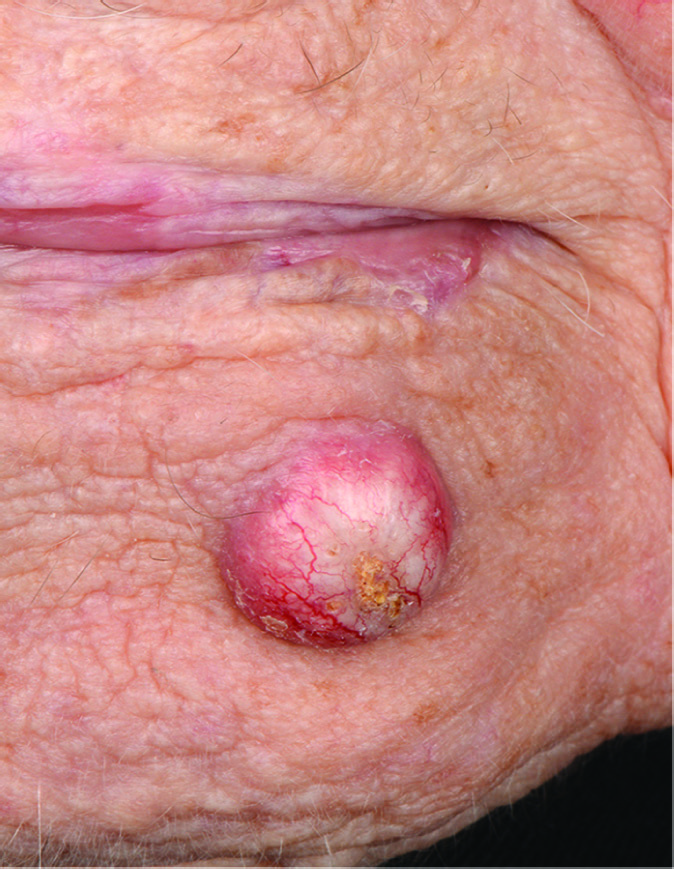
Fig. 108.9 Clinical spectrum of keratoacanthomas. A, B Erythematous nodules that are yellow–white centrally with a keratotic core; telangiectasias are also seen. C, D Rapidly growing, erythematous crateriform nodules with a rolled border and larger central keratotic core. The lesions may be tender. E Progressive peripheral expansion and central involution with residual atrophy characterize keratoacanthoma centrifugum marginatum. F Giant keratoacanthoma with a yellow–red color, multilobed rolled border, central ulceration, and a history of rapid growth.
Fig.108.9 As.246
Fig. 108.9 Clinical spectrum of keratoacanthomas. A, B Erythematous nodules that are yellow–white centrally with a keratotic core; telangiectasias are also seen. C, D Rapidly growing, erythematous crateriform nodules with a rolled border and larger central keratotic core. The lesions may be tender. E Progressive peripheral expansion and central involution with residual atrophy characterize keratoacanthoma centrifugum marginatum. F Giant keratoacanthoma with a yellow–red color, multilobed rolled border, central ulceration, and a history of rapid growth.
Fig.108.9 Bs.246
Fig. 108.9 Clinical spectrum of keratoacanthomas. A, B Erythematous nodules that are yellow–white centrally with a keratotic core; telangiectasias are also seen. C, D Rapidly growing, erythematous crateriform nodules with a rolled border and larger central keratotic core. The lesions may be tender. E Progressive peripheral expansion and central involution with residual atrophy characterize keratoacanthoma centrifugum marginatum. F Giant keratoacanthoma with a yellow–red color, multilobed rolled border, central ulceration, and a history of rapid growth.
Fig.108.9 Cs.246
Fig. 108.9 Clinical spectrum of keratoacanthomas. A, B Erythematous nodules that are yellow–white centrally with a keratotic core; telangiectasias are also seen. C, D Rapidly growing, erythematous crateriform nodules with a rolled border and larger central keratotic core. The lesions may be tender. E Progressive peripheral expansion and central involution with residual atrophy characterize keratoacanthoma centrifugum marginatum. F Giant keratoacanthoma with a yellow–red color, multilobed rolled border, central ulceration, and a history of rapid growth.
Fig.108.9 Ds.246
Fig. 108.9 Clinical spectrum of keratoacanthomas. A, B Erythematous nodules that are yellow–white centrally with a keratotic core; telangiectasias are also seen. C, D Rapidly growing, erythematous crateriform nodules with a rolled border and larger central keratotic core. The lesions may be tender. E Progressive peripheral expansion and central involution with residual atrophy characterize keratoacanthoma centrifugum marginatum. F Giant keratoacanthoma with a yellow–red color, multilobed rolled border, central ulceration, and a history of rapid growth.
Fig.108.9 Es.246
(Fig. 108.10A,B). They are commonly associated with HPV infection, and distinguishing between a verrucous carcinoma and a large wart or condyloma acuminatum can be challenging. Gradual penetration of verrucous carcinomas into underlying tissues can result in destruction of subcutis, fascia, and bone. These tumors can arise within scars and amputation stumps (Fig. 108.10C) as well as in association with fistulae of osteomyelitis and chronic venous insufficiency. Verrucous carcinomas often recur after attempted removal, but they usually do not metastasize, except for recurrent or irradiated tumors with anaplastic transformation. Some authors consider subungual KAs, proliferating tricholemmal cysts (proliferating pilar tumors), and papillomatosis cutis carcinoides (which favors the shins and dorsal feet) to be subtypes of verrucous carcinoma.
Fig.108.10A,Bs.246
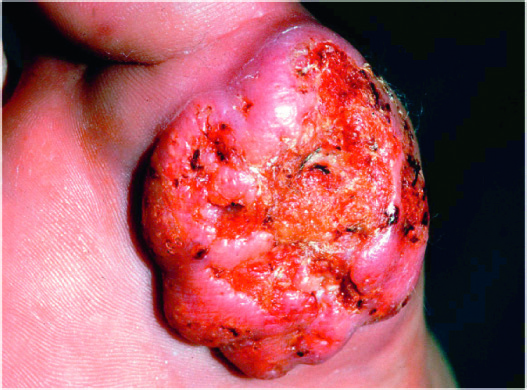
Fig. 108.10 Verrucous carcinoma. A Longstanding large nodule on the plantar surface with a rabbit burrow-like appearance; such a tumor is also referred to as an epithelioma cuniculatum. B Keratotic and ulcerated plaque on the ventro- medial aspect of the great toe. C A classic location in an amputation stump. In general, these well-differentiated SCCs enlarge slowly.
Fig.108.10 As.247
Fig. 108.10 Verrucous carcinoma. A Longstanding large nodule on the plantar surface with a rabbit burrow-like appearance; such a tumor is also referred to as an epithelioma cuniculatum. B Keratotic and ulcerated plaque on the ventro- medial aspect of the great toe. C A classic location in an amputation stump. In general, these well-differentiated SCCs enlarge slowly.
Fig.108.10 Bs.247
Fig. 108.10 Verrucous carcinoma. A Longstanding large nodule on the plantar surface with a rabbit burrow-like appearance; such a tumor is also referred to as an epithelioma cuniculatum. B Keratotic and ulcerated plaque on the ventro- medial aspect of the great toe. C A classic location in an amputation stump. In general, these well-differentiated SCCs enlarge slowly.
Fig.108.10 Cs.247
Fig. 108.10 Verrucous carcinoma. A Longstanding large nodule on the plantar surface with a rabbit burrow-like appearance; such a tumor is also referred to as an epithelioma cuniculatum. B Keratotic and ulcerated plaque on the ventro- medial aspect of the great toe. C A classic location in an amputation stump. In general, these well-differentiated SCCs enlarge slowly.
Fig.108.10 Ds.247
Fig. 108.17 Additional variants of basal cell carcinoma (BCC) – pigmented and fibroepithelial (fibroepithelioma of Pinkus). A, B Pigmented nodular BCCs with varying degrees of melanin pigmentation that may clinically resemble cutaneous melanoma. However, the glassy translucency, in concert with characteristic dermo- scopic features such as arborizing telangiectasias and multiple blue–gray ovoid globules (C), point to the diagnosis of pigmented BCC. D A soft, skin-colored to light pink, broad, sessile plaque on the lower back is a classic presentation for a fibroepithelial BCC. A, Courtesy Kalman Watsky, MD; C, Courtesy Giuseppe Argenziano, MD; D, Courtesy Oscar Colegio, MD.
Fig.108.17 As.250
Fig. 108.17 Additional variants of basal cell carcinoma (BCC) – pigmented and fibroepithelial (fibroepithelioma of Pinkus). A, B Pigmented nodular BCCs with varying degrees of melanin pigmentation that may clinically resemble cutaneous melanoma. However, the glassy translucency, in concert with characteristic dermo- scopic features such as arborizing telangiectasias and multiple blue–gray ovoid globules (C), point to the diagnosis of pigmented BCC. D A soft, skin-colored to light pink, broad, sessile plaque on the lower back is a classic presentation for a fibroepithelial BCC. A, Courtesy Kalman Watsky, MD; C, Courtesy Giuseppe Argenziano, MD; D, Courtesy Oscar Colegio, MD.
Fig.108.17 Bs.250
Fig. 108.17 Additional variants of basal cell carcinoma (BCC) – pigmented and fibroepithelial (fibroepithelioma of Pinkus). A, B Pigmented nodular BCCs with varying degrees of melanin pigmentation that may clinically resemble cutaneous melanoma. However, the glassy translucency, in concert with characteristic dermo- scopic features such as arborizing telangiectasias and multiple blue–gray ovoid globules (C), point to the diagnosis of pigmented BCC. D A soft, skin-colored to light pink, broad, sessile plaque on the lower back is a classic presentation for a fibroepithelial BCC. A, Courtesy Kalman Watsky, MD; C, Courtesy Giuseppe Argenziano, MD; D, Courtesy Oscar Colegio, MD.
Fig.108.17 Cs.250
Fig. 108.17 Additional variants of basal cell carcinoma (BCC) – pigmented and fibroepithelial (fibroepithelioma of Pinkus). A, B Pigmented nodular BCCs with varying degrees of melanin pigmentation that may clinically resemble cutaneous melanoma. However, the glassy translucency, in concert with characteristic dermo- scopic features such as arborizing telangiectasias and multiple blue–gray ovoid globules (C), point to the diagnosis of pigmented BCC. D A soft, skin-colored to light pink, broad, sessile plaque on the lower back is a classic presentation for a fibroepithelial BCC. A, Courtesy Kalman Watsky, MD; C, Courtesy Giuseppe Argenziano, MD; D, Courtesy Oscar Colegio, MD.
Fig.108.17 Ds.250
Fig. 108.17 Additional variants of basal cell carcinoma (BCC) – pigmented and fibroepithelial (fibroepithelioma of Pinkus). A, B Pigmented nodular BCCs with varying degrees of melanin pigmentation that may clinically resemble cutaneous melanoma. However, the glassy translucency, in concert with characteristic dermo- scopic features such as arborizing telangiectasias and multiple blue–gray ovoid globules (C), point to the diagnosis of pigmented BCC. D A soft, skin-colored to light pink, broad, sessile plaque on the lower back is a classic presentation for a fibroepithelial BCC. A, Courtesy Kalman Watsky, MD; C, Courtesy Giuseppe Argenziano, MD; D, Courtesy Oscar Colegio, MD.
Fig.108.17 Es.250
Fig. 108.17 Additional variants of basal cell carcinoma (BCC) – pigmented and fibroepithelial (fibroepithelioma of Pinkus). A, B Pigmented nodular BCCs with varying degrees of melanin pigmentation that may clinically resemble cutaneous melanoma. However, the glassy translucency, in concert with characteristic dermo- scopic features such as arborizing telangiectasias and multiple blue–gray ovoid globules (C), point to the diagnosis of pigmented BCC. D A soft, skin-colored to light pink, broad, sessile plaque on the lower back is a classic presentation for a fibroepithelial BCC. A, Courtesy Kalman Watsky, MD; C, Courtesy Giuseppe Argenziano, MD; D, Courtesy Oscar Colegio, MD.
Fig.108.17 Fs.250
Fig. 108.17 Additional variants of basal cell carcinoma (BCC) – pigmented and fibroepithelial (fibroepithelioma of Pinkus). A, B Pigmented nodular BCCs with varying degrees of melanin pigmentation that may clinically resemble cutaneous melanoma. However, the glassy translucency, in concert with characteristic dermo- scopic features such as arborizing telangiectasias and multiple blue–gray ovoid globules (C), point to the diagnosis of pigmented BCC. D A soft, skin-colored to light pink, broad, sessile plaque on the lower back is a classic presentation for a fibroepithelial BCC. A, Courtesy Kalman Watsky, MD; C, Courtesy Giuseppe Argenziano, MD; D, Courtesy Oscar Colegio, MD.
Fig.108.17 Gs.250
Fig. 108.18 Superficial basal cell carcinomas. A Numerous erythematous patches and thin plaques on the back of a man with a history of arsenic exposure decades previ- ously. B A solitary large, thin, dark pink plaque. There are scattered areas of fine scaling and small foci of brown pigment within the rolled border. As a rule, these lesions are neither pruritic nor tender.
Fig.108.18 As.251
Fig. 108.18 Superficial basal cell carcinomas. A Numerous erythematous patches and thin plaques on the back of a man with a history of arsenic exposure decades previ- ously. B A solitary large, thin, dark pink plaque. There are scattered areas of fine scaling and small foci of brown pigment within the rolled border. As a rule, these lesions are neither pruritic nor tender.
Fig.108.18 Bs.251
Fig. 108.18 Superficial basal cell carcinomas. A Numerous erythematous patches and thin plaques on the back of a man with a history of arsenic exposure decades previ- ously. B A solitary large, thin, dark pink plaque. There are scattered areas of fine scaling and small foci of brown pigment within the rolled border. As a rule, these lesions are neither pruritic nor tender.
Fig.108.18 Cs.251
Fig. 108.19 Morpheaform basal cell carcinomas. A Recurrent tumor two years after microscopically controlled surgery; note the scar-like appearance with superimposed glassy pink and brown papules. B Oval hypopigmented firm plaque that resembles a scar (e. g. post electrodesiccation and curettage). While there is a light pink color between 9 and 12 o’clock, no translucency or rolled border is present. C A classic example with indistinct borders and scar-like appearance.
Fig.108.19 As.251
Fig. 108.19 Morpheaform basal cell carcinomas. A Recurrent tumor two years after microscopically controlled surgery; note the scar-like appearance with superimposed glassy pink and brown papules. B Oval hypopigmented firm plaque that resembles a scar (e. g. post electrodesiccation and curettage). While there is a light pink color between 9 and 12 o’clock, no translucency or rolled border is present. C A classic example with indistinct borders and scar-like appearance.
Fig.108.19 Bs.251
Fig. 108.19 Morpheaform basal cell carcinomas. A Recurrent tumor two years after microscopically controlled surgery; note the scar-like appearance with superimposed glassy pink and brown papules. B Oval hypopigmented firm plaque that resembles a scar (e. g. post electrodesiccation and curettage). While there is a light pink color between 9 and 12 o’clock, no translucency or rolled border is present. C A classic example with indistinct borders and scar-like appearance.
Fig.108.19 Cs.251
Fig. 108.19 Morpheaform basal cell carcinomas. A Recurrent tumor two years after microscopically controlled surgery; note the scar-like appearance with superimposed glassy pink and brown papules. B Oval hypopigmented firm plaque that resembles a scar (e. g. post electrodesiccation and curettage). While there is a light pink color between 9 and 12 o’clock, no translucency or rolled border is present. C A classic example with indistinct borders and scar-like appearance.
Fig.108.19 Ds.251
Fig. 108.23 Locally advanced basal cell carcinoma treated with vismodegib. A Large ulcerated tumor of the central chest. B Nearly complete regression following administration of vismodegib (150 mg daily) for 10 weeks.
Fig.108.23 As.257
Fig. 108.23 Locally advanced basal cell carcinoma treated with vismodegib. A Large ulcerated tumor of the central chest. B Nearly complete regression following administration of vismodegib (150 mg daily) for 10 weeks.
Fig.108.23 Bs.257