Bolognia 5e·Dermatoloji Çalışma Paneli
Ch 77

Mantar Hastalıkları

Vol 2 · sayfa 1343 · §12
📖 Özet🃏 Flashcard Quiz🖼 Atlas
Fig. 77.2 Tinea nigra. Single, sharply demar- cated brown macule on the finger. Courtesy Frank Samarin, MD.
Fig.77.2s.1631
Fig. 77.3 Tinea (pityriasis) versicolor. A Hyperpigmented variant with confluence on the lower chest. B Hypopigmented variant on the face. C Coalescing pink lesions with fine scale. D Yeast and short hyphal forms in the stratum corneum highlighted by a PAS stain (inset). A, B, Courtesy Kalman Watsky, MD; D, Courtesy Lorenzo Cerroni, MD.
Fig.77.3 As.1631
Fig. 77.3 Tinea (pityriasis) versicolor. A Hyperpigmented variant with confluence on the lower chest. B Hypopigmented variant on the face. C Coalescing pink lesions with fine scale. D Yeast and short hyphal forms in the stratum corneum highlighted by a PAS stain (inset). A, B, Courtesy Kalman Watsky, MD; D, Courtesy Lorenzo Cerroni, MD.
Fig.77.3 Bs.1631
Fig. 77.4 White piedra. Potassium hydroxide preparation of a nodule on a hair shaft composed of arthroconidia and blastoconidia.
Fig.77.4s.1632
Fig. 77.5 Potassium hydroxide preparations. A Superficial skin scrapings from tinea (pityriasis) versicolor demonstrating clusters of yeast and short mycelial forms. B A dermatophyte, in this case Trichophyton tonsurans, demonstrating branching hyphae (chlorazol black stain). Note that the hyphae cross multiple squamous cells. C “Mosaic” pattern of cell walls that should not be misinterpreted as hyphae. D Yeast and pseudohyphae of candidiasis. A, Courtesy Ronald P. Rapini, MD; C, Courtesy Louis A. Fragola, Jr, MD; D, Courtesy Frank Samarin, MD.
Fig.77.5 As.1632
Fig. 77.5 Potassium hydroxide preparations. A Superficial skin scrapings from tinea (pityriasis) versicolor demonstrating clusters of yeast and short mycelial forms. B A dermatophyte, in this case Trichophyton tonsurans, demonstrating branching hyphae (chlorazol black stain). Note that the hyphae cross multiple squamous cells. C “Mosaic” pattern of cell walls that should not be misinterpreted as hyphae. D Yeast and pseudohyphae of candidiasis. A, Courtesy Ronald P. Rapini, MD; C, Courtesy Louis A. Fragola, Jr, MD; D, Courtesy Frank Samarin, MD.
Fig.77.5 Bs.1632
Fig. 77.5 Potassium hydroxide preparations. A Superficial skin scrapings from tinea (pityriasis) versicolor demonstrating clusters of yeast and short mycelial forms. B A dermatophyte, in this case Trichophyton tonsurans, demonstrating branching hyphae (chlorazol black stain). Note that the hyphae cross multiple squamous cells. C “Mosaic” pattern of cell walls that should not be misinterpreted as hyphae. D Yeast and pseudohyphae of candidiasis. A, Courtesy Ronald P. Rapini, MD; C, Courtesy Louis A. Fragola, Jr, MD; D, Courtesy Frank Samarin, MD.
Fig.77.5 Cs.1632
Fig. 77.5 Potassium hydroxide preparations. A Superficial skin scrapings from tinea (pityriasis) versicolor demonstrating clusters of yeast and short mycelial forms. B A dermatophyte, in this case Trichophyton tonsurans, demonstrating branching hyphae (chlorazol black stain). Note that the hyphae cross multiple squamous cells. C “Mosaic” pattern of cell walls that should not be misinterpreted as hyphae. D Yeast and pseudohyphae of candidiasis. A, Courtesy Ronald P. Rapini, MD; C, Courtesy Louis A. Fragola, Jr, MD; D, Courtesy Frank Samarin, MD.
Fig.77.5 Ds.1632
Fig. 77.6 Tinea corporis. A There is a subtle annular configuration with a border composed of individual, slightly scaly papules. B Classic annular lesion with a scaly raised border and central clearing. C Annular lesion with trailing scale reminiscent of erythema annulare centrifugum. D Multiple annular and circinate lesions of various sizes on the upper back. E Scaly concentric rings on the arm. F Pustules within multiple figurate lesions on the upper arm. G Inflammatory nodules on the dorsal hand and a thick granulomatous plaque on the distal forearm (tinea profunda). There is associated scale, including on the digits, and a few of the papulo- nodules are follicular (Majocchi granuloma). B, D, Courtesy Julie V. Schaffer, MD; C, G Courtesy Kalman Watsky, MD.
Fig.77.6 As.1636
Fig. 77.6 Tinea corporis. A There is a subtle annular configuration with a border composed of individual, slightly scaly papules. B Classic annular lesion with a scaly raised border and central clearing. C Annular lesion with trailing scale reminiscent of erythema annulare centrifugum. D Multiple annular and circinate lesions of various sizes on the upper back. E Scaly concentric rings on the arm. F Pustules within multiple figurate lesions on the upper arm. G Inflammatory nodules on the dorsal hand and a thick granulomatous plaque on the distal forearm (tinea profunda). There is associated scale, including on the digits, and a few of the papulo- nodules are follicular (Majocchi granuloma). B, D, Courtesy Julie V. Schaffer, MD; C, G Courtesy Kalman Watsky, MD.
Fig.77.6 Bs.1636
Fig. 77.6 Tinea corporis. A There is a subtle annular configuration with a border composed of individual, slightly scaly papules. B Classic annular lesion with a scaly raised border and central clearing. C Annular lesion with trailing scale reminiscent of erythema annulare centrifugum. D Multiple annular and circinate lesions of various sizes on the upper back. E Scaly concentric rings on the arm. F Pustules within multiple figurate lesions on the upper arm. G Inflammatory nodules on the dorsal hand and a thick granulomatous plaque on the distal forearm (tinea profunda). There is associated scale, including on the digits, and a few of the papulo- nodules are follicular (Majocchi granuloma). B, D, Courtesy Julie V. Schaffer, MD; C, G Courtesy Kalman Watsky, MD.
Fig.77.6 Cs.1636
Fig. 77.6 Tinea corporis. A There is a subtle annular configuration with a border composed of individual, slightly scaly papules. B Classic annular lesion with a scaly raised border and central clearing. C Annular lesion with trailing scale reminiscent of erythema annulare centrifugum. D Multiple annular and circinate lesions of various sizes on the upper back. E Scaly concentric rings on the arm. F Pustules within multiple figurate lesions on the upper arm. G Inflammatory nodules on the dorsal hand and a thick granulomatous plaque on the distal forearm (tinea profunda). There is associated scale, including on the digits, and a few of the papulo- nodules are follicular (Majocchi granuloma). B, D, Courtesy Julie V. Schaffer, MD; C, G Courtesy Kalman Watsky, MD.
Fig.77.6 Ds.1636
Fig. 77.6 Tinea corporis. A There is a subtle annular configuration with a border composed of individual, slightly scaly papules. B Classic annular lesion with a scaly raised border and central clearing. C Annular lesion with trailing scale reminiscent of erythema annulare centrifugum. D Multiple annular and circinate lesions of various sizes on the upper back. E Scaly concentric rings on the arm. F Pustules within multiple figurate lesions on the upper arm. G Inflammatory nodules on the dorsal hand and a thick granulomatous plaque on the distal forearm (tinea profunda). There is associated scale, including on the digits, and a few of the papulo- nodules are follicular (Majocchi granuloma). B, D, Courtesy Julie V. Schaffer, MD; C, G Courtesy Kalman Watsky, MD.
Fig.77.6 Es.1636
Fig. 77.6 Tinea corporis. A There is a subtle annular configuration with a border composed of individual, slightly scaly papules. B Classic annular lesion with a scaly raised border and central clearing. C Annular lesion with trailing scale reminiscent of erythema annulare centrifugum. D Multiple annular and circinate lesions of various sizes on the upper back. E Scaly concentric rings on the arm. F Pustules within multiple figurate lesions on the upper arm. G Inflammatory nodules on the dorsal hand and a thick granulomatous plaque on the distal forearm (tinea profunda). There is associated scale, including on the digits, and a few of the papulo- nodules are follicular (Majocchi granuloma). B, D, Courtesy Julie V. Schaffer, MD; C, G Courtesy Kalman Watsky, MD.
Fig.77.6 Fs.1636
Fig. 77.6 Tinea corporis. A There is a subtle annular configuration with a border composed of individual, slightly scaly papules. B Classic annular lesion with a scaly raised border and central clearing. C Annular lesion with trailing scale reminiscent of erythema annulare centrifugum. D Multiple annular and circinate lesions of various sizes on the upper back. E Scaly concentric rings on the arm. F Pustules within multiple figurate lesions on the upper arm. G Inflammatory nodules on the dorsal hand and a thick granulomatous plaque on the distal forearm (tinea profunda). There is associated scale, including on the digits, and a few of the papulo- nodules are follicular (Majocchi granuloma). B, D, Courtesy Julie V. Schaffer, MD; C, G Courtesy Kalman Watsky, MD.
Fig.77.6 Gs.1636
Fig. 77.7 Tinea incognito. Use of potent topical corticosteroids for the presumed diagnosis of dermatitis is a common clinical scenario. Numerous hyphae are usually seen on KOH examination. Courtesy Louis A. Fragola, Jr, MD.
Fig.77.7 As.1636
Fig. 77.7 Tinea incognito. Use of potent topical corticosteroids for the presumed diagnosis of dermatitis is a common clinical scenario. Numerous hyphae are usually seen on KOH examination. Courtesy Louis A. Fragola, Jr, MD.
Fig.77.7 Bs.1636
Fig. 77.8 Nodular perifolliculitis (Majocchi granuloma). Perifollicular inflam- mation and follicular pustules on the leg due to Trichophyton rubrum. A few of the lowermost papules have a granulomatous appearance. Courtesy Kalman Watsky, MD.
Fig.77.8s.1636
Fig. 77.9 Tinea cruris. A thin, “broken-up” erythematous plaque with an arciform papular border on the upper inner thigh.
Fig.77.9s.1637
Fig. 77.10 Tinea manuum. A Diffuse scaling of the palm of one hand, with accentuation in the creases. B Multiple collarettes of scale reminiscent of keratolysis exfoliativa on one palm.
Fig.77.10 As.1637
Fig. 77.10 Tinea manuum. A Diffuse scaling of the palm of one hand, with accentuation in the creases. B Multiple collarettes of scale reminiscent of keratolysis exfoliativa on one palm.
Fig.77.10 Bs.1637
Fig. 77.11 Superficial form of tinea barbae due to Trichophyton rubrum. Several follicular pustules are evident. Courtesy Jean L. Bolognia, MD.
Fig.77.11s.1637
Fig. 77.12 Tinea faciei. A Erythema and scale on the nose and philtrum of a young child. The location and lack of central clearing may lead to the misdiagnosis of dermatitis with secondary impetiginization. B Child with pink papules, a few tiny pustules, and thin annular and arcuate scaly plaques in a perinasal and perioral distribution. These clinical findings could be mistaken for periorificial dermatitis. C Hyperpigmented lesions with subtle arcuate and annular configurations in a woman with darkly pigmented skin. There is minimal scale following the use of topical corticosteroids (“tinea incognito”). The clue to the application of topical corti- costeroids is the relative hypopigmentation as compared with the more medial cheek. A, Courtesy Julie V. Schaffer, MD; B, Courtesy Antonio Torrelo, MD; C, Courtesy Kalman Watsky, MD.
Fig.77.12 As.1638
Fig. 77.12 Tinea faciei. A Erythema and scale on the nose and philtrum of a young child. The location and lack of central clearing may lead to the misdiagnosis of dermatitis with secondary impetiginization. B Child with pink papules, a few tiny pustules, and thin annular and arcuate scaly plaques in a perinasal and perioral distribution. These clinical findings could be mistaken for periorificial dermatitis. C Hyperpigmented lesions with subtle arcuate and annular configurations in a woman with darkly pigmented skin. There is minimal scale following the use of topical corticosteroids (“tinea incognito”). The clue to the application of topical corti- costeroids is the relative hypopigmentation as compared with the more medial cheek. A, Courtesy Julie V. Schaffer, MD; B, Courtesy Antonio Torrelo, MD; C, Courtesy Kalman Watsky, MD.
Fig.77.12 Bs.1638
Fig. 77.12 Tinea faciei. A Erythema and scale on the nose and philtrum of a young child. The location and lack of central clearing may lead to the misdiagnosis of dermatitis with secondary impetiginization. B Child with pink papules, a few tiny pustules, and thin annular and arcuate scaly plaques in a perinasal and perioral distribution. These clinical findings could be mistaken for periorificial dermatitis. C Hyperpigmented lesions with subtle arcuate and annular configurations in a woman with darkly pigmented skin. There is minimal scale following the use of topical corticosteroids (“tinea incognito”). The clue to the application of topical corti- costeroids is the relative hypopigmentation as compared with the more medial cheek. A, Courtesy Julie V. Schaffer, MD; B, Courtesy Antonio Torrelo, MD; C, Courtesy Kalman Watsky, MD.
Fig.77.12 Cs.1638
Fig. 77.12 Tinea faciei. A Erythema and scale on the nose and philtrum of a young child. The location and lack of central clearing may lead to the misdiagnosis of dermatitis with secondary impetiginization. B Child with pink papules, a few tiny pustules, and thin annular and arcuate scaly plaques in a perinasal and perioral distribution. These clinical findings could be mistaken for periorificial dermatitis. C Hyperpigmented lesions with subtle arcuate and annular configurations in a woman with darkly pigmented skin. There is minimal scale following the use of topical corticosteroids (“tinea incognito”). The clue to the application of topical corti- costeroids is the relative hypopigmentation as compared with the more medial cheek. A, Courtesy Julie V. Schaffer, MD; B, Courtesy Antonio Torrelo, MD; C, Courtesy Kalman Watsky, MD.
Fig.77.12 Ds.1638
Fig. 77.12 Tinea faciei. A Erythema and scale on the nose and philtrum of a young child. The location and lack of central clearing may lead to the misdiagnosis of dermatitis with secondary impetiginization. B Child with pink papules, a few tiny pustules, and thin annular and arcuate scaly plaques in a perinasal and perioral distribution. These clinical findings could be mistaken for periorificial dermatitis. C Hyperpigmented lesions with subtle arcuate and annular configurations in a woman with darkly pigmented skin. There is minimal scale following the use of topical corticosteroids (“tinea incognito”). The clue to the application of topical corti- costeroids is the relative hypopigmentation as compared with the more medial cheek. A, Courtesy Julie V. Schaffer, MD; B, Courtesy Antonio Torrelo, MD; C, Courtesy Kalman Watsky, MD.
Fig.77.12 Es.1638
Fig. 77.12 Tinea faciei. A Erythema and scale on the nose and philtrum of a young child. The location and lack of central clearing may lead to the misdiagnosis of dermatitis with secondary impetiginization. B Child with pink papules, a few tiny pustules, and thin annular and arcuate scaly plaques in a perinasal and perioral distribution. These clinical findings could be mistaken for periorificial dermatitis. C Hyperpigmented lesions with subtle arcuate and annular configurations in a woman with darkly pigmented skin. There is minimal scale following the use of topical corticosteroids (“tinea incognito”). The clue to the application of topical corti- costeroids is the relative hypopigmentation as compared with the more medial cheek. A, Courtesy Julie V. Schaffer, MD; B, Courtesy Antonio Torrelo, MD; C, Courtesy Kalman Watsky, MD.
Fig.77.12 Fs.1638
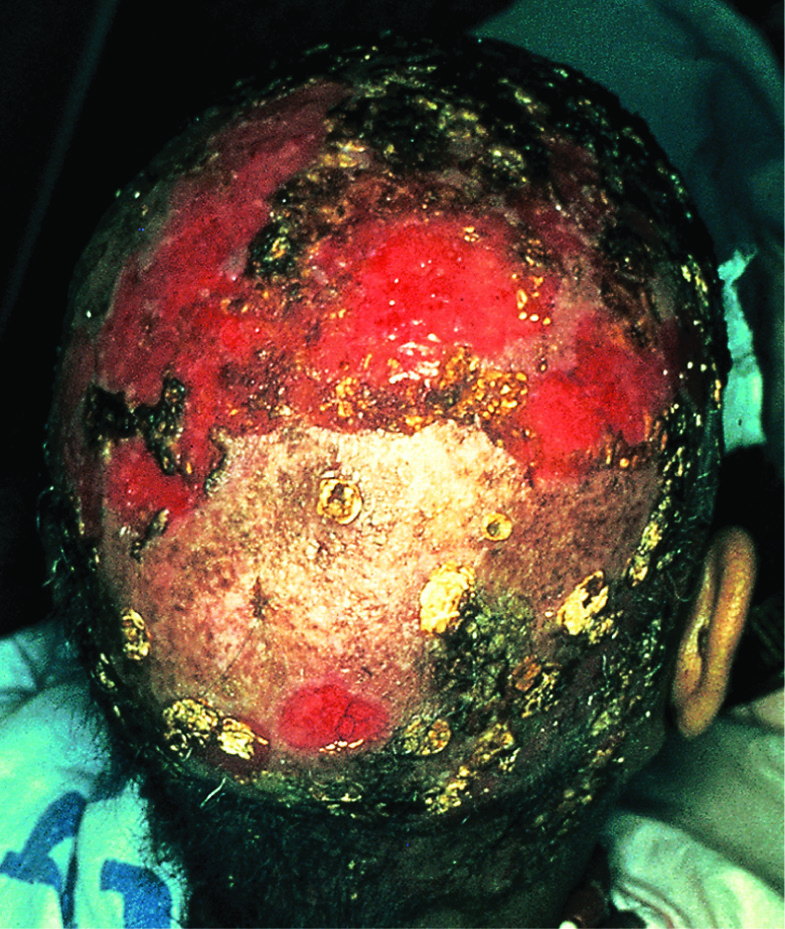
Fig. 77.13 Tinea capitis. The range of clinical presentations of tinea capitis due to Trichophyton tonsurans, from mild scalp scaling (A) to patchy alopecia with black dots (B) or scale (C) to large areas of alopecia with pustules and scale-crust (D). E, F Kerion formation due to T. tonsurans. G Microscopic examination of involved hairs demonstrates an endothrix pattern (KOH–chlorazol black stain). H Histologic examination shows arthroconidia and hyphae within hair shafts to the level of Adamson’s fringe (limit of the zone of keratinization; inset). B, Courtesy Louis A. Fragola, Jr, MD; F, Courtesy Robert Browdell, MD; H, Courtesy Lorenzo Cerroni, MD.
Fig.77.13 As.1638
Fig. 77.13 Tinea capitis. The range of clinical presentations of tinea capitis due to Trichophyton tonsurans, from mild scalp scaling (A) to patchy alopecia with black dots (B) or scale (C) to large areas of alopecia with pustules and scale-crust (D). E, F Kerion formation due to T. tonsurans. G Microscopic examination of involved hairs demonstrates an endothrix pattern (KOH–chlorazol black stain). H Histologic examination shows arthroconidia and hyphae within hair shafts to the level of Adamson’s fringe (limit of the zone of keratinization; inset). B, Courtesy Louis A. Fragola, Jr, MD; F, Courtesy Robert Browdell, MD; H, Courtesy Lorenzo Cerroni, MD.
Fig.77.13 Bs.1638
Fig. 77.13 Tinea capitis. The range of clinical presentations of tinea capitis due to Trichophyton tonsurans, from mild scalp scaling (A) to patchy alopecia with black dots (B) or scale (C) to large areas of alopecia with pustules and scale-crust (D). E, F Kerion formation due to T. tonsurans. G Microscopic examination of involved hairs demonstrates an endothrix pattern (KOH–chlorazol black stain). H Histologic examination shows arthroconidia and hyphae within hair shafts to the level of Adamson’s fringe (limit of the zone of keratinization; inset). B, Courtesy Louis A. Fragola, Jr, MD; F, Courtesy Robert Browdell, MD; H, Courtesy Lorenzo Cerroni, MD.
Fig.77.13 Cs.1638
Fig. 77.15 Favus due to Trichophyton schoenleinii. Scarring alopecia with erosions and several scutula on the occipital scalp. The latter represent masses of keratin plus fungi. Courtesy Israel Dvoretzky, MD.
Fig.77.15s.1639
Fig. 77.16 Tinea pedis A Diffuse scaling on both feet (moccasin type) as well as on the right hand, representing “one hand–two feet” tinea. B Maceration and scaling between the fourth and fifth toes in the interdigital form. C Erythema, scale-crust, and bullae in the inflammatory form. D Extension of tinea pedis onto the dorsal foot in a serpiginous configuration of erythema and papules. Scale is minimal due to the patient’s use of a potent topical corticosteroid for presumed derma- titis. B, D, Courtesy Julie V. Schaffer, MD.
Fig.77.16 As.1640
Fig. 77.16 Tinea pedis A Diffuse scaling on both feet (moccasin type) as well as on the right hand, representing “one hand–two feet” tinea. B Maceration and scaling between the fourth and fifth toes in the interdigital form. C Erythema, scale-crust, and bullae in the inflammatory form. D Extension of tinea pedis onto the dorsal foot in a serpiginous configuration of erythema and papules. Scale is minimal due to the patient’s use of a potent topical corticosteroid for presumed derma- titis. B, D, Courtesy Julie V. Schaffer, MD.
Fig.77.16 Bs.1640
Fig. 77.16 Tinea pedis A Diffuse scaling on both feet (moccasin type) as well as on the right hand, representing “one hand–two feet” tinea. B Maceration and scaling between the fourth and fifth toes in the interdigital form. C Erythema, scale-crust, and bullae in the inflammatory form. D Extension of tinea pedis onto the dorsal foot in a serpiginous configuration of erythema and papules. Scale is minimal due to the patient’s use of a potent topical corticosteroid for presumed derma- titis. B, D, Courtesy Julie V. Schaffer, MD.
Fig.77.16 Cs.1640
Fig. 77.16 Tinea pedis A Diffuse scaling on both feet (moccasin type) as well as on the right hand, representing “one hand–two feet” tinea. B Maceration and scaling between the fourth and fifth toes in the interdigital form. C Erythema, scale-crust, and bullae in the inflammatory form. D Extension of tinea pedis onto the dorsal foot in a serpiginous configuration of erythema and papules. Scale is minimal due to the patient’s use of a potent topical corticosteroid for presumed derma- titis. B, D, Courtesy Julie V. Schaffer, MD.
Fig.77.16 Ds.1640
Fig. 77.17 Extensive tinea corporis emanating from tinea manuum and tinea pedis. Note the confluent involvement, serpiginous scaly borders, and associated tinea unguium of the toenails and one fingernail.
Fig.77.17 As.1641
Fig. 77.17 Extensive tinea corporis emanating from tinea manuum and tinea pedis. Note the confluent involvement, serpiginous scaly borders, and associated tinea unguium of the toenails and one fingernail.
Fig.77.17 Bs.1641
Fig. 77.17 Extensive tinea corporis emanating from tinea manuum and tinea pedis. Note the confluent involvement, serpiginous scaly borders, and associated tinea unguium of the toenails and one fingernail.
Fig.77.17 Cs.1641
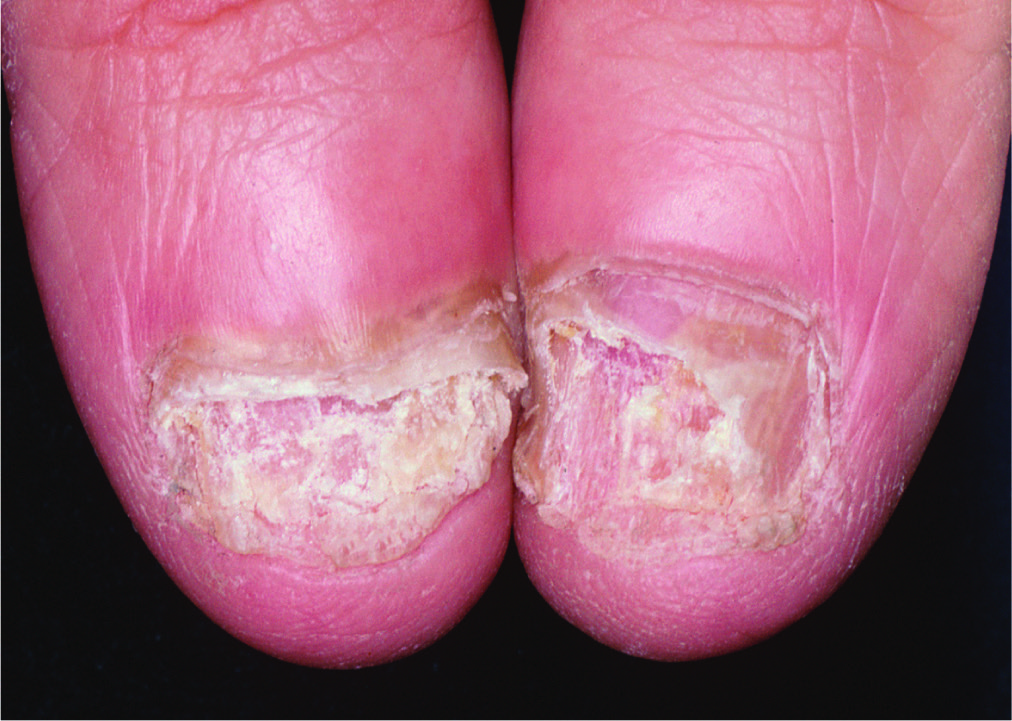
Fig. 77.18 Tinea unguium. Onycholysis, yellowing, crumbling and thickening of the fingernails (A), thumb nails (B), and toenails (C) in the distal/lateral subungual variant. D White discoloration of the toenail in the superficial white variant. E Hyphae within a formalin-fixed, PAS-stained nail plate. A, D Courtesy Jean L. Bolognia, MD; B, Courtesy Louis A. Fragola, Jr, MD; E, Courtesy Mary Stone, MD.
Fig.77.18 As.1641
Fig. 77.18 Tinea unguium. Onycholysis, yellowing, crumbling and thickening of the fingernails (A), thumb nails (B), and toenails (C) in the distal/lateral subungual variant. D White discoloration of the toenail in the superficial white variant. E Hyphae within a formalin-fixed, PAS-stained nail plate. A, D Courtesy Jean L. Bolognia, MD; B, Courtesy Louis A. Fragola, Jr, MD; E, Courtesy Mary Stone, MD.
Fig.77.18 Bs.1641
Fig. 77.18 Tinea unguium. Onycholysis, yellowing, crumbling and thickening of the fingernails (A), thumb nails (B), and toenails (C) in the distal/lateral subungual variant. D White discoloration of the toenail in the superficial white variant. E Hyphae within a formalin-fixed, PAS-stained nail plate. A, D Courtesy Jean L. Bolognia, MD; B, Courtesy Louis A. Fragola, Jr, MD; E, Courtesy Mary Stone, MD.
Fig.77.18 Cs.1641
Fig. 77.21 Invasive dermatophytosis due to Trichophyton rubrum in an immunocompromised host. Courtesy Evelyn Lilly, MD.
Fig.77.21s.1644
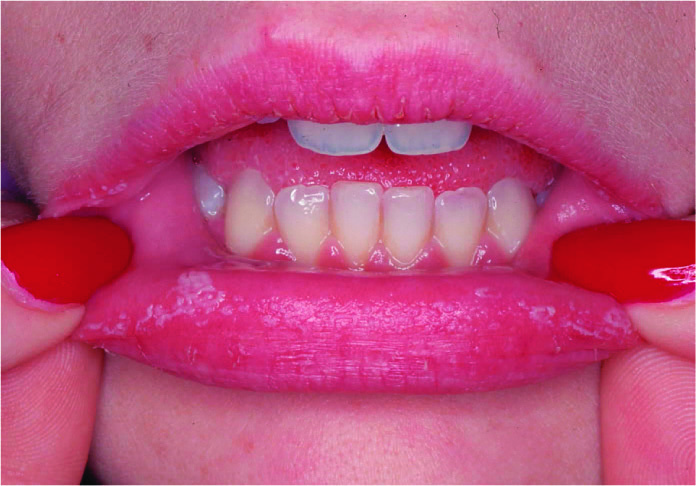
Fig. 77.22 Mucocutaneous candi- diasis. A Thrush with “cottage cheese”- like exudate on the buccal mucosa in a man with AIDS. B Thrush and candidal cheilitis. C Angular cheilitis (perlèche). D Candidiasis of the supra- pubic area and penis in a young boy. Note the collarettes of scale on the coalescing, brightly erythematous papules. E Candidiasis of the scrotum and medial thighs with beefy red erythema, scale, and satellite papules. F This infection occurred in a hospi- talized patient with diabetes mellitus who was receiving broad-spectrum antibiotics. Note the multiple satellite lesions. G Erosive interdigital candi- diasis (erosio interdigitalis blastomy- cetica) in the classic location between the third and fourth fingers. H Dermal candidiasis in an immunosuppressed patient. I Early-onset cutaneous candi- diasis in a term neonate. Widespread pink papules, some of which have collarettes of white scale, admixed with small pustules. This typically results from intrauterine acquisition and may be present at birth or appear during the first six days of life. B, D Courtesy Louis A. Fragola, Jr, MD; C, Courtesy Kalman Watsky, MD; E, G, Courtesy Eugene Mirrer, MD; I, Courtesy Antonio Torrelo, MD.
Fig.77.22 As.1645
Fig. 77.22 Mucocutaneous candi- diasis. A Thrush with “cottage cheese”- like exudate on the buccal mucosa in a man with AIDS. B Thrush and candidal cheilitis. C Angular cheilitis (perlèche). D Candidiasis of the supra- pubic area and penis in a young boy. Note the collarettes of scale on the coalescing, brightly erythematous papules. E Candidiasis of the scrotum and medial thighs with beefy red erythema, scale, and satellite papules. F This infection occurred in a hospi- talized patient with diabetes mellitus who was receiving broad-spectrum antibiotics. Note the multiple satellite lesions. G Erosive interdigital candi- diasis (erosio interdigitalis blastomy- cetica) in the classic location between the third and fourth fingers. H Dermal candidiasis in an immunosuppressed patient. I Early-onset cutaneous candi- diasis in a term neonate. Widespread pink papules, some of which have collarettes of white scale, admixed with small pustules. This typically results from intrauterine acquisition and may be present at birth or appear during the first six days of life. B, D Courtesy Louis A. Fragola, Jr, MD; C, Courtesy Kalman Watsky, MD; E, G, Courtesy Eugene Mirrer, MD; I, Courtesy Antonio Torrelo, MD.
Fig.77.22 Bs.1645
Fig. 77.22 Mucocutaneous candi- diasis. A Thrush with “cottage cheese”- like exudate on the buccal mucosa in a man with AIDS. B Thrush and candidal cheilitis. C Angular cheilitis (perlèche). D Candidiasis of the supra- pubic area and penis in a young boy. Note the collarettes of scale on the coalescing, brightly erythematous papules. E Candidiasis of the scrotum and medial thighs with beefy red erythema, scale, and satellite papules. F This infection occurred in a hospi- talized patient with diabetes mellitus who was receiving broad-spectrum antibiotics. Note the multiple satellite lesions. G Erosive interdigital candi- diasis (erosio interdigitalis blastomy- cetica) in the classic location between the third and fourth fingers. H Dermal candidiasis in an immunosuppressed patient. I Early-onset cutaneous candi- diasis in a term neonate. Widespread pink papules, some of which have collarettes of white scale, admixed with small pustules. This typically results from intrauterine acquisition and may be present at birth or appear during the first six days of life. B, D Courtesy Louis A. Fragola, Jr, MD; C, Courtesy Kalman Watsky, MD; E, G, Courtesy Eugene Mirrer, MD; I, Courtesy Antonio Torrelo, MD.
Fig.77.22 Cs.1645
Fig. 77.22 Mucocutaneous candi- diasis. A Thrush with “cottage cheese”- like exudate on the buccal mucosa in a man with AIDS. B Thrush and candidal cheilitis. C Angular cheilitis (perlèche). D Candidiasis of the supra- pubic area and penis in a young boy. Note the collarettes of scale on the coalescing, brightly erythematous papules. E Candidiasis of the scrotum and medial thighs with beefy red erythema, scale, and satellite papules. F This infection occurred in a hospi- talized patient with diabetes mellitus who was receiving broad-spectrum antibiotics. Note the multiple satellite lesions. G Erosive interdigital candi- diasis (erosio interdigitalis blastomy- cetica) in the classic location between the third and fourth fingers. H Dermal candidiasis in an immunosuppressed patient. I Early-onset cutaneous candi- diasis in a term neonate. Widespread pink papules, some of which have collarettes of white scale, admixed with small pustules. This typically results from intrauterine acquisition and may be present at birth or appear during the first six days of life. B, D Courtesy Louis A. Fragola, Jr, MD; C, Courtesy Kalman Watsky, MD; E, G, Courtesy Eugene Mirrer, MD; I, Courtesy Antonio Torrelo, MD.
Fig.77.22 Ds.1645
Fig. 77.22 Mucocutaneous candi- diasis. A Thrush with “cottage cheese”- like exudate on the buccal mucosa in a man with AIDS. B Thrush and candidal cheilitis. C Angular cheilitis (perlèche). D Candidiasis of the supra- pubic area and penis in a young boy. Note the collarettes of scale on the coalescing, brightly erythematous papules. E Candidiasis of the scrotum and medial thighs with beefy red erythema, scale, and satellite papules. F This infection occurred in a hospi- talized patient with diabetes mellitus who was receiving broad-spectrum antibiotics. Note the multiple satellite lesions. G Erosive interdigital candi- diasis (erosio interdigitalis blastomy- cetica) in the classic location between the third and fourth fingers. H Dermal candidiasis in an immunosuppressed patient. I Early-onset cutaneous candi- diasis in a term neonate. Widespread pink papules, some of which have collarettes of white scale, admixed with small pustules. This typically results from intrauterine acquisition and may be present at birth or appear during the first six days of life. B, D Courtesy Louis A. Fragola, Jr, MD; C, Courtesy Kalman Watsky, MD; E, G, Courtesy Eugene Mirrer, MD; I, Courtesy Antonio Torrelo, MD.
Fig.77.22 Es.1645
Fig. 77.22 Mucocutaneous candi- diasis. A Thrush with “cottage cheese”- like exudate on the buccal mucosa in a man with AIDS. B Thrush and candidal cheilitis. C Angular cheilitis (perlèche). D Candidiasis of the supra- pubic area and penis in a young boy. Note the collarettes of scale on the coalescing, brightly erythematous papules. E Candidiasis of the scrotum and medial thighs with beefy red erythema, scale, and satellite papules. F This infection occurred in a hospi- talized patient with diabetes mellitus who was receiving broad-spectrum antibiotics. Note the multiple satellite lesions. G Erosive interdigital candi- diasis (erosio interdigitalis blastomy- cetica) in the classic location between the third and fourth fingers. H Dermal candidiasis in an immunosuppressed patient. I Early-onset cutaneous candi- diasis in a term neonate. Widespread pink papules, some of which have collarettes of white scale, admixed with small pustules. This typically results from intrauterine acquisition and may be present at birth or appear during the first six days of life. B, D Courtesy Louis A. Fragola, Jr, MD; C, Courtesy Kalman Watsky, MD; E, G, Courtesy Eugene Mirrer, MD; I, Courtesy Antonio Torrelo, MD.
Fig.77.22 Fs.1645
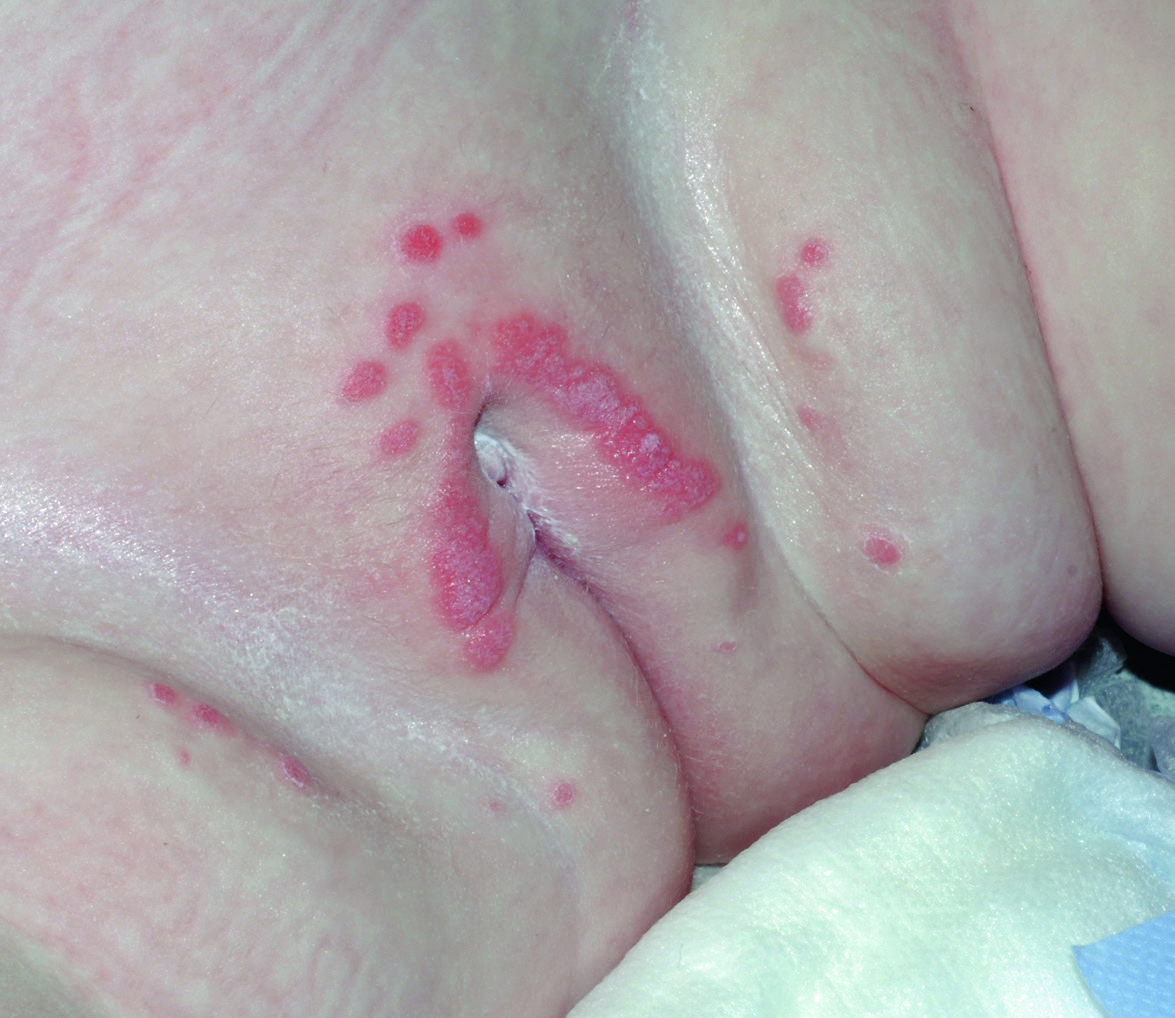
Fig. 77.23 Granuloma gluteale infantum. Coalescing moist, pink papules on the vulva and suprapubic area of an infant. Courtesy Julie V. Schaffer, MD.
Fig.77.23 As.1647
Fig. 77.23 Granuloma gluteale infantum. Coalescing moist, pink papules on the vulva and suprapubic area of an infant. Courtesy Julie V. Schaffer, MD.
Fig.77.23 Bs.1647
Fig. 77.23 Granuloma gluteale infantum. Coalescing moist, pink papules on the vulva and suprapubic area of an infant. Courtesy Julie V. Schaffer, MD.
Fig.77.23 Cs.1647
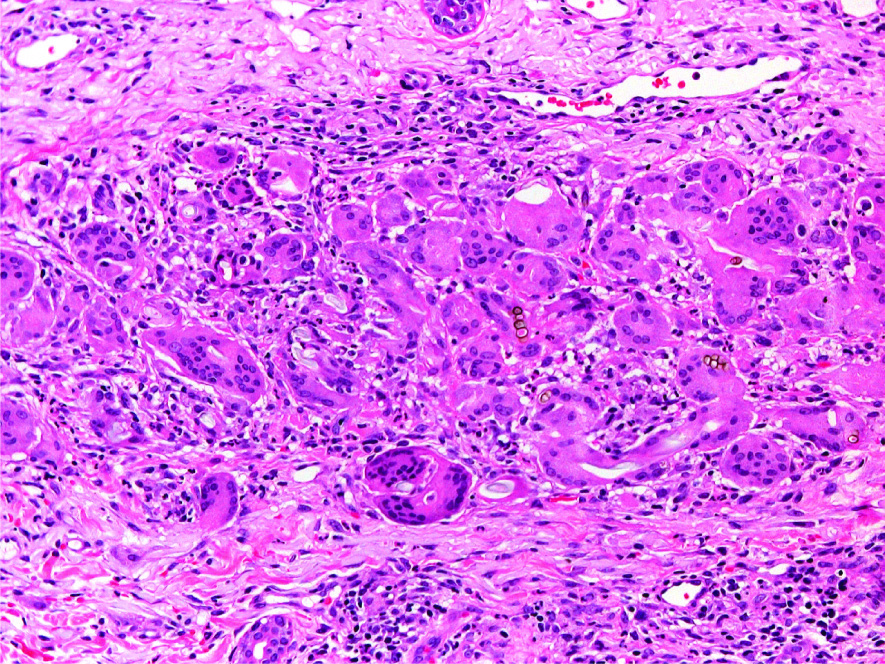
Fig. 77.24 Chromoblastomycosis. Annular and figurate plaques due to central clearing and scarring with a verrucous surface on the arm (A) and a more granulo- matous appearance on the leg (B). C Brown-colored sclerotic body (inset) within a mixed granulomatous and neutrophilic dermal infiltrate. C, Courtesy C. Massone, MD.
Fig.77.24 As.1647
Fig. 77.24 Chromoblastomycosis. Annular and figurate plaques due to central clearing and scarring with a verrucous surface on the arm (A) and a more granulo- matous appearance on the leg (B). C Brown-colored sclerotic body (inset) within a mixed granulomatous and neutrophilic dermal infiltrate. C, Courtesy C. Massone, MD.
Fig.77.24 Bs.1647
Nocardiosis (Fig. 77.26B) Pyogenic bacteria (e.g. Staphylococcus aureus, Streptococcus pyogenes) Pseudallescheria boydii/Scedosporium apiospermum
Fig.77.26Bs.1650
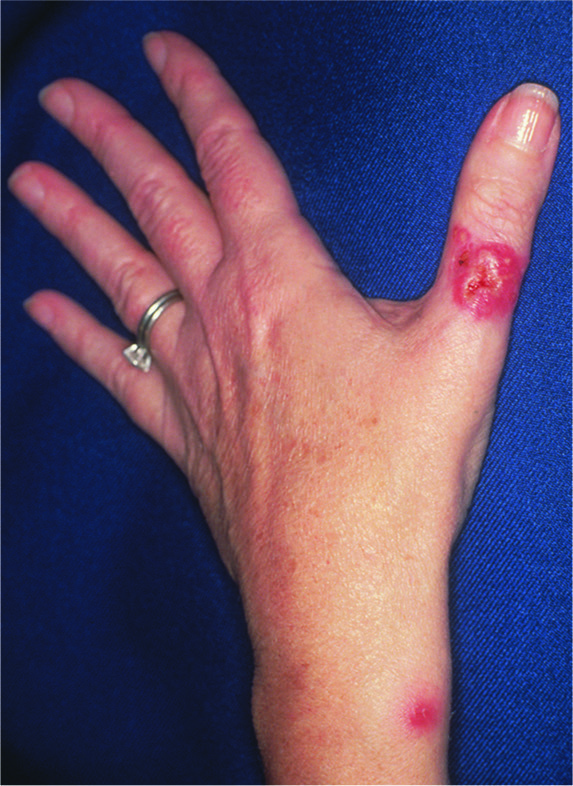
Fig. 77.26 Lymphocutaneous (sporotrichoid) pattern. A An eroded nodule on the thumb representing the primary lesion with a secondary lesion along the lymphatics due to sporotrichosis. B Ulcerated nodule on the extensor forearm with multiple more proximal nodules due to nocardiosis in a patient with lymphoma who was receiving systemic corticosteroids. C Granulomatous plaques with evidence of upward spread along the lymphatics. D Multiple yeast forms of Sporothrix schenckii in the dermis; note that many of the organisms have the characteristic cigar shape. B, Courtesy Jean L. Bolognia, MD; C, Courtesy Luis Requena, MD; D, Courtesy Ronald P. Rapini, MD.
Fig.77.26 As.1649
Fig. 77.26 Lymphocutaneous (sporotrichoid) pattern. A An eroded nodule on the thumb representing the primary lesion with a secondary lesion along the lymphatics due to sporotrichosis. B Ulcerated nodule on the extensor forearm with multiple more proximal nodules due to nocardiosis in a patient with lymphoma who was receiving systemic corticosteroids. C Granulomatous plaques with evidence of upward spread along the lymphatics. D Multiple yeast forms of Sporothrix schenckii in the dermis; note that many of the organisms have the characteristic cigar shape. B, Courtesy Jean L. Bolognia, MD; C, Courtesy Luis Requena, MD; D, Courtesy Ronald P. Rapini, MD.
Fig.77.26 Bs.1649
Fig. 77.26 Lymphocutaneous (sporotrichoid) pattern. A An eroded nodule on the thumb representing the primary lesion with a secondary lesion along the lymphatics due to sporotrichosis. B Ulcerated nodule on the extensor forearm with multiple more proximal nodules due to nocardiosis in a patient with lymphoma who was receiving systemic corticosteroids. C Granulomatous plaques with evidence of upward spread along the lymphatics. D Multiple yeast forms of Sporothrix schenckii in the dermis; note that many of the organisms have the characteristic cigar shape. B, Courtesy Jean L. Bolognia, MD; C, Courtesy Luis Requena, MD; D, Courtesy Ronald P. Rapini, MD.
Fig.77.26 Cs.1649
Fig. 77.26 Lymphocutaneous (sporotrichoid) pattern. A An eroded nodule on the thumb representing the primary lesion with a secondary lesion along the lymphatics due to sporotrichosis. B Ulcerated nodule on the extensor forearm with multiple more proximal nodules due to nocardiosis in a patient with lymphoma who was receiving systemic corticosteroids. C Granulomatous plaques with evidence of upward spread along the lymphatics. D Multiple yeast forms of Sporothrix schenckii in the dermis; note that many of the organisms have the characteristic cigar shape. B, Courtesy Jean L. Bolognia, MD; C, Courtesy Luis Requena, MD; D, Courtesy Ronald P. Rapini, MD.
Fig.77.26 Ds.1649
Fig. 77.27 Lobomycosis. A, B Multinodular pinkish-brown plaques with a keloid-like appearance on the helix and back. C Spherical organisms with doubly refractile walls are seen within the dermis. Chain formation is commonly observed (inset; methenamine silver stain). A, B, Courtesy Regina Carneiro, MD and Caroline Brandao, MD; C, Courtesy C. Massone, MD.
Fig.77.27 As.1650
Fig. 77.27 Lobomycosis. A, B Multinodular pinkish-brown plaques with a keloid-like appearance on the helix and back. C Spherical organisms with doubly refractile walls are seen within the dermis. Chain formation is commonly observed (inset; methenamine silver stain). A, B, Courtesy Regina Carneiro, MD and Caroline Brandao, MD; C, Courtesy C. Massone, MD.
Fig.77.27 Bs.1650
Fig. 77.29 Histoplasmosis. A, B Disseminated papules and nodules with scale-crust in a patient with AIDS. C Numerous yeasts within giant cells as well as dermal macrophages. D The organisms are highlighted with a methenamine silver stain (inset). C, Courtesy Jennifer McNiff, MD; D, Courtesy C. Massone, MD.
Fig.77.29 As.1652
Fig. 77.29 Histoplasmosis. A, B Disseminated papules and nodules with scale-crust in a patient with AIDS. C Numerous yeasts within giant cells as well as dermal macrophages. D The organisms are highlighted with a methenamine silver stain (inset). C, Courtesy Jennifer McNiff, MD; D, Courtesy C. Massone, MD.
Fig.77.29 Bs.1652
Fig. 77.29 Histoplasmosis. A, B Disseminated papules and nodules with scale-crust in a patient with AIDS. C Numerous yeasts within giant cells as well as dermal macrophages. D The organisms are highlighted with a methenamine silver stain (inset). C, Courtesy Jennifer McNiff, MD; D, Courtesy C. Massone, MD.
Fig.77.29 Cs.1652
Fig. 77.29 Histoplasmosis. A, B Disseminated papules and nodules with scale-crust in a patient with AIDS. C Numerous yeasts within giant cells as well as dermal macrophages. D The organisms are highlighted with a methenamine silver stain (inset). C, Courtesy Jennifer McNiff, MD; D, Courtesy C. Massone, MD.
Fig.77.29 Ds.1652
Fig. 77.29 Histoplasmosis. A, B Disseminated papules and nodules with scale-crust in a patient with AIDS. C Numerous yeasts within giant cells as well as dermal macrophages. D The organisms are highlighted with a methenamine silver stain (inset). C, Courtesy Jennifer McNiff, MD; D, Courtesy C. Massone, MD.
Fig.77.29 Es.1652
Fig. 77.30 Blastomycosis. A Facial plaque with scale-crust and a border with a granulomatous appearance. B Well-demarcated plaques with erosions, central scarring, and black crusting. C Verrucous plaque with focal crusting on the medial thigh. D Budding yeast forms in the dermis, several of which are within a giant cell (PAS stain). Note the single, broad-based budding (arrow). A, Courtesy Louis A. Fragola, Jr, MD; B, Courtesy Paul Lucky, MD; C, Courtesy Elizabeth Ergen, MD; D, Courtesy Mary Stone, MD.
Fig.77.30 As.1653
Fig. 77.30 Blastomycosis. A Facial plaque with scale-crust and a border with a granulomatous appearance. B Well-demarcated plaques with erosions, central scarring, and black crusting. C Verrucous plaque with focal crusting on the medial thigh. D Budding yeast forms in the dermis, several of which are within a giant cell (PAS stain). Note the single, broad-based budding (arrow). A, Courtesy Louis A. Fragola, Jr, MD; B, Courtesy Paul Lucky, MD; C, Courtesy Elizabeth Ergen, MD; D, Courtesy Mary Stone, MD.
Fig.77.30 Bs.1653
Fig. 77.30 Blastomycosis. A Facial plaque with scale-crust and a border with a granulomatous appearance. B Well-demarcated plaques with erosions, central scarring, and black crusting. C Verrucous plaque with focal crusting on the medial thigh. D Budding yeast forms in the dermis, several of which are within a giant cell (PAS stain). Note the single, broad-based budding (arrow). A, Courtesy Louis A. Fragola, Jr, MD; B, Courtesy Paul Lucky, MD; C, Courtesy Elizabeth Ergen, MD; D, Courtesy Mary Stone, MD.
Fig.77.30 Cs.1653
Fig. 77.30 Blastomycosis. A Facial plaque with scale-crust and a border with a granulomatous appearance. B Well-demarcated plaques with erosions, central scarring, and black crusting. C Verrucous plaque with focal crusting on the medial thigh. D Budding yeast forms in the dermis, several of which are within a giant cell (PAS stain). Note the single, broad-based budding (arrow). A, Courtesy Louis A. Fragola, Jr, MD; B, Courtesy Paul Lucky, MD; C, Courtesy Elizabeth Ergen, MD; D, Courtesy Mary Stone, MD.
Fig.77.30 Ds.1653
Fig. 77.31 Coccidioidomycosis. Moist erythematous plaque on the face (A) and multiple papules and suppurative nodules on the arm (B) in two patients living in the southwestern US. C An endospore-containing spherule within a giant cell. C, Courtesy Jennifer McNiff, MD.
Fig.77.31 As.1654
Fig. 77.31 Coccidioidomycosis. Moist erythematous plaque on the face (A) and multiple papules and suppurative nodules on the arm (B) in two patients living in the southwestern US. C An endospore-containing spherule within a giant cell. C, Courtesy Jennifer McNiff, MD.
Fig.77.31 Bs.1654
Fig. 77.32 Life cycle of Coccidioides immitis and C. posadasii.
Fig.77.32s.1654
Fig. 77.33 Paracoccidioidomycosis. Ulcerated plaques on the palate (A) and verrucous granulomatous red– brown plaques with crusting involving the perioral region and upper lip (B). C Dermal histiocytic infiltrate and yeast forms with multiple small, narrow-based buds. The organisms are highlighted with a methenamine silver stain (inset). A, B, Courtesy Marcia Ramos-e-Silva, MD, PhD; C, Courtesy C. Massone, MD.
Fig.77.33 As.1655
Fig. 77.33 Paracoccidioidomycosis. Ulcerated plaques on the palate (A) and verrucous granulomatous red– brown plaques with crusting involving the perioral region and upper lip (B). C Dermal histiocytic infiltrate and yeast forms with multiple small, narrow-based buds. The organisms are highlighted with a methenamine silver stain (inset). A, B, Courtesy Marcia Ramos-e-Silva, MD, PhD; C, Courtesy C. Massone, MD.
Fig.77.33 Bs.1655
Fig. 77.33 Paracoccidioidomycosis. Ulcerated plaques on the palate (A) and verrucous granulomatous red– brown plaques with crusting involving the perioral region and upper lip (B). C Dermal histiocytic infiltrate and yeast forms with multiple small, narrow-based buds. The organisms are highlighted with a methenamine silver stain (inset). A, B, Courtesy Marcia Ramos-e-Silva, MD, PhD; C, Courtesy C. Massone, MD.
Fig.77.33 Cs.1655
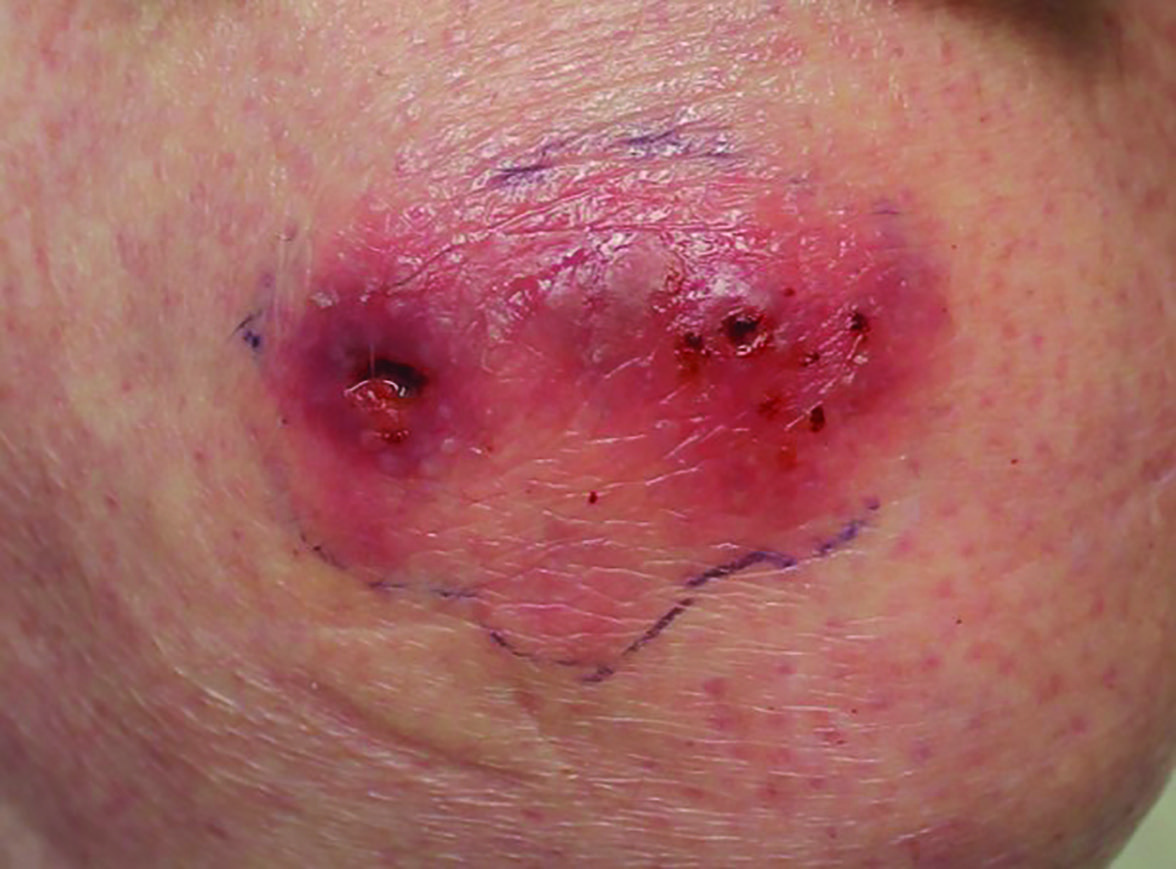
Fig. 77.35 Clinical findings of opportunistic fungal infections in immunocompromised hosts. Primary cutaneous aspergillosis characterized by hyperpigmented plaques with brown–black scale-crusts at the site of intravenous catheters on the arm (A); firm pink papulonodule due to disseminated candidiasis (B); erythematous papulonodules with central purpura, vesiculation and/or crusting in a leukemic patient with disseminated fusariosis (C); hemorrhagic vesicle representing a Fusarium solani septic embolus in a patient with acute lymphoblastic leukemia (D); necrotic hemorrhagic bulla due to embolus of Aspergillus flavus (E); cellulitis with large areas of necrosis due to Rhizopus (F) and cryptococcosis (G); cryptococcal cellulitis mimicking bacterial cellulitis (H); disseminated cryptococcosis presenting with crusted lesion(s) resembling molluscum contagiosum (I) and a basal cell carcinoma (J); cryptococcal cellulitis (K); numerous papules and nodules with central umbilication and crusting in disseminated Talaromyces (Penicillium) marneffei infection (L). D, Courtesy Edward Cowen, MD; H, Courtesy Catherine Baker, MD; L, Courtesy Evangeline Handog, MD and the Dermatology Department, Research Institute for Tropical Medicine.
Fig.77.35 As.1657
Fig. 77.35 Clinical findings of opportunistic fungal infections in immunocompromised hosts. Primary cutaneous aspergillosis characterized by hyperpigmented plaques with brown–black scale-crusts at the site of intravenous catheters on the arm (A); firm pink papulonodule due to disseminated candidiasis (B); erythematous papulonodules with central purpura, vesiculation and/or crusting in a leukemic patient with disseminated fusariosis (C); hemorrhagic vesicle representing a Fusarium solani septic embolus in a patient with acute lymphoblastic leukemia (D); necrotic hemorrhagic bulla due to embolus of Aspergillus flavus (E); cellulitis with large areas of necrosis due to Rhizopus (F) and cryptococcosis (G); cryptococcal cellulitis mimicking bacterial cellulitis (H); disseminated cryptococcosis presenting with crusted lesion(s) resembling molluscum contagiosum (I) and a basal cell carcinoma (J); cryptococcal cellulitis (K); numerous papules and nodules with central umbilication and crusting in disseminated Talaromyces (Penicillium) marneffei infection (L). D, Courtesy Edward Cowen, MD; H, Courtesy Catherine Baker, MD; L, Courtesy Evangeline Handog, MD and the Dermatology Department, Research Institute for Tropical Medicine.
Fig.77.35 Bs.1657
Fig. 77.35 Clinical findings of opportunistic fungal infections in immunocompromised hosts. Primary cutaneous aspergillosis characterized by hyperpigmented plaques with brown–black scale-crusts at the site of intravenous catheters on the arm (A); firm pink papulonodule due to disseminated candidiasis (B); erythematous papulonodules with central purpura, vesiculation and/or crusting in a leukemic patient with disseminated fusariosis (C); hemorrhagic vesicle representing a Fusarium solani septic embolus in a patient with acute lymphoblastic leukemia (D); necrotic hemorrhagic bulla due to embolus of Aspergillus flavus (E); cellulitis with large areas of necrosis due to Rhizopus (F) and cryptococcosis (G); cryptococcal cellulitis mimicking bacterial cellulitis (H); disseminated cryptococcosis presenting with crusted lesion(s) resembling molluscum contagiosum (I) and a basal cell carcinoma (J); cryptococcal cellulitis (K); numerous papules and nodules with central umbilication and crusting in disseminated Talaromyces (Penicillium) marneffei infection (L). D, Courtesy Edward Cowen, MD; H, Courtesy Catherine Baker, MD; L, Courtesy Evangeline Handog, MD and the Dermatology Department, Research Institute for Tropical Medicine.
Fig.77.35 Cs.1657
Fig. 77.35 Clinical findings of opportunistic fungal infections in immunocompromised hosts. Primary cutaneous aspergillosis characterized by hyperpigmented plaques with brown–black scale-crusts at the site of intravenous catheters on the arm (A); firm pink papulonodule due to disseminated candidiasis (B); erythematous papulonodules with central purpura, vesiculation and/or crusting in a leukemic patient with disseminated fusariosis (C); hemorrhagic vesicle representing a Fusarium solani septic embolus in a patient with acute lymphoblastic leukemia (D); necrotic hemorrhagic bulla due to embolus of Aspergillus flavus (E); cellulitis with large areas of necrosis due to Rhizopus (F) and cryptococcosis (G); cryptococcal cellulitis mimicking bacterial cellulitis (H); disseminated cryptococcosis presenting with crusted lesion(s) resembling molluscum contagiosum (I) and a basal cell carcinoma (J); cryptococcal cellulitis (K); numerous papules and nodules with central umbilication and crusting in disseminated Talaromyces (Penicillium) marneffei infection (L). D, Courtesy Edward Cowen, MD; H, Courtesy Catherine Baker, MD; L, Courtesy Evangeline Handog, MD and the Dermatology Department, Research Institute for Tropical Medicine.
Fig.77.35 Ds.1657
Fig. 77.35 Clinical findings of opportunistic fungal infections in immunocompromised hosts. Primary cutaneous aspergillosis characterized by hyperpigmented plaques with brown–black scale-crusts at the site of intravenous catheters on the arm (A); firm pink papulonodule due to disseminated candidiasis (B); erythematous papulonodules with central purpura, vesiculation and/or crusting in a leukemic patient with disseminated fusariosis (C); hemorrhagic vesicle representing a Fusarium solani septic embolus in a patient with acute lymphoblastic leukemia (D); necrotic hemorrhagic bulla due to embolus of Aspergillus flavus (E); cellulitis with large areas of necrosis due to Rhizopus (F) and cryptococcosis (G); cryptococcal cellulitis mimicking bacterial cellulitis (H); disseminated cryptococcosis presenting with crusted lesion(s) resembling molluscum contagiosum (I) and a basal cell carcinoma (J); cryptococcal cellulitis (K); numerous papules and nodules with central umbilication and crusting in disseminated Talaromyces (Penicillium) marneffei infection (L). D, Courtesy Edward Cowen, MD; H, Courtesy Catherine Baker, MD; L, Courtesy Evangeline Handog, MD and the Dermatology Department, Research Institute for Tropical Medicine.
Fig.77.35 Es.1657
Fig. 77.35 Clinical findings of opportunistic fungal infections in immunocompromised hosts. Primary cutaneous aspergillosis characterized by hyperpigmented plaques with brown–black scale-crusts at the site of intravenous catheters on the arm (A); firm pink papulonodule due to disseminated candidiasis (B); erythematous papulonodules with central purpura, vesiculation and/or crusting in a leukemic patient with disseminated fusariosis (C); hemorrhagic vesicle representing a Fusarium solani septic embolus in a patient with acute lymphoblastic leukemia (D); necrotic hemorrhagic bulla due to embolus of Aspergillus flavus (E); cellulitis with large areas of necrosis due to Rhizopus (F) and cryptococcosis (G); cryptococcal cellulitis mimicking bacterial cellulitis (H); disseminated cryptococcosis presenting with crusted lesion(s) resembling molluscum contagiosum (I) and a basal cell carcinoma (J); cryptococcal cellulitis (K); numerous papules and nodules with central umbilication and crusting in disseminated Talaromyces (Penicillium) marneffei infection (L). D, Courtesy Edward Cowen, MD; H, Courtesy Catherine Baker, MD; L, Courtesy Evangeline Handog, MD and the Dermatology Department, Research Institute for Tropical Medicine.
Fig.77.35 Fs.1657
Fig. 77.35 Clinical findings of opportunistic fungal infections in immunocompromised hosts. Primary cutaneous aspergillosis characterized by hyperpigmented plaques with brown–black scale-crusts at the site of intravenous catheters on the arm (A); firm pink papulonodule due to disseminated candidiasis (B); erythematous papulonodules with central purpura, vesiculation and/or crusting in a leukemic patient with disseminated fusariosis (C); hemorrhagic vesicle representing a Fusarium solani septic embolus in a patient with acute lymphoblastic leukemia (D); necrotic hemorrhagic bulla due to embolus of Aspergillus flavus (E); cellulitis with large areas of necrosis due to Rhizopus (F) and cryptococcosis (G); cryptococcal cellulitis mimicking bacterial cellulitis (H); disseminated cryptococcosis presenting with crusted lesion(s) resembling molluscum contagiosum (I) and a basal cell carcinoma (J); cryptococcal cellulitis (K); numerous papules and nodules with central umbilication and crusting in disseminated Talaromyces (Penicillium) marneffei infection (L). D, Courtesy Edward Cowen, MD; H, Courtesy Catherine Baker, MD; L, Courtesy Evangeline Handog, MD and the Dermatology Department, Research Institute for Tropical Medicine.
Fig.77.35 Gs.1657
Fig. 77.36 Histologic findings of opportunistic fungal infections in immuno- compromised hosts. A Septate hyphae (arrow) within necrotic skin from a patient with disseminated aspergillosis. B Ribbon-like, non-septate Rhizopus hyphae in a “touch” preparation of dermal scrapings from the base of a necrotic bulla. C Numerous dermal yeast forms with gelatinous capsules in secondary cutaneous cryptococcosis (PAS stain). A, Courtesy Lorenzo Cerroni, MD; B, Courtesy Jean L. Bolognia, MD; C, Courtesy Athanasia Syrengelas, MD, PhD.
Fig.77.36s.1658